RXB PLUS ROTARY SCREW COMPRESSOR UNITSS70-101 IOM
Page 62
GROUNDING
Grounding is the most important factor for successful op-
eration and is also the most overlooked. The NEC states
that control equipment may be grounded by using the rigid
conduit as a conductor. This worked for the earlier relay
systems, but it is not acceptable for electronic control equip-
ment. Conduit is made of steel and is a poor conductor rela-
tive to a copper wire. Electronic equipment reacts to very
small currents and must have a good ground in order to
operate properly; therefore, copper grounds are required
for proper operation. Note: aluminum may be used for the
large three-phase ground wire.
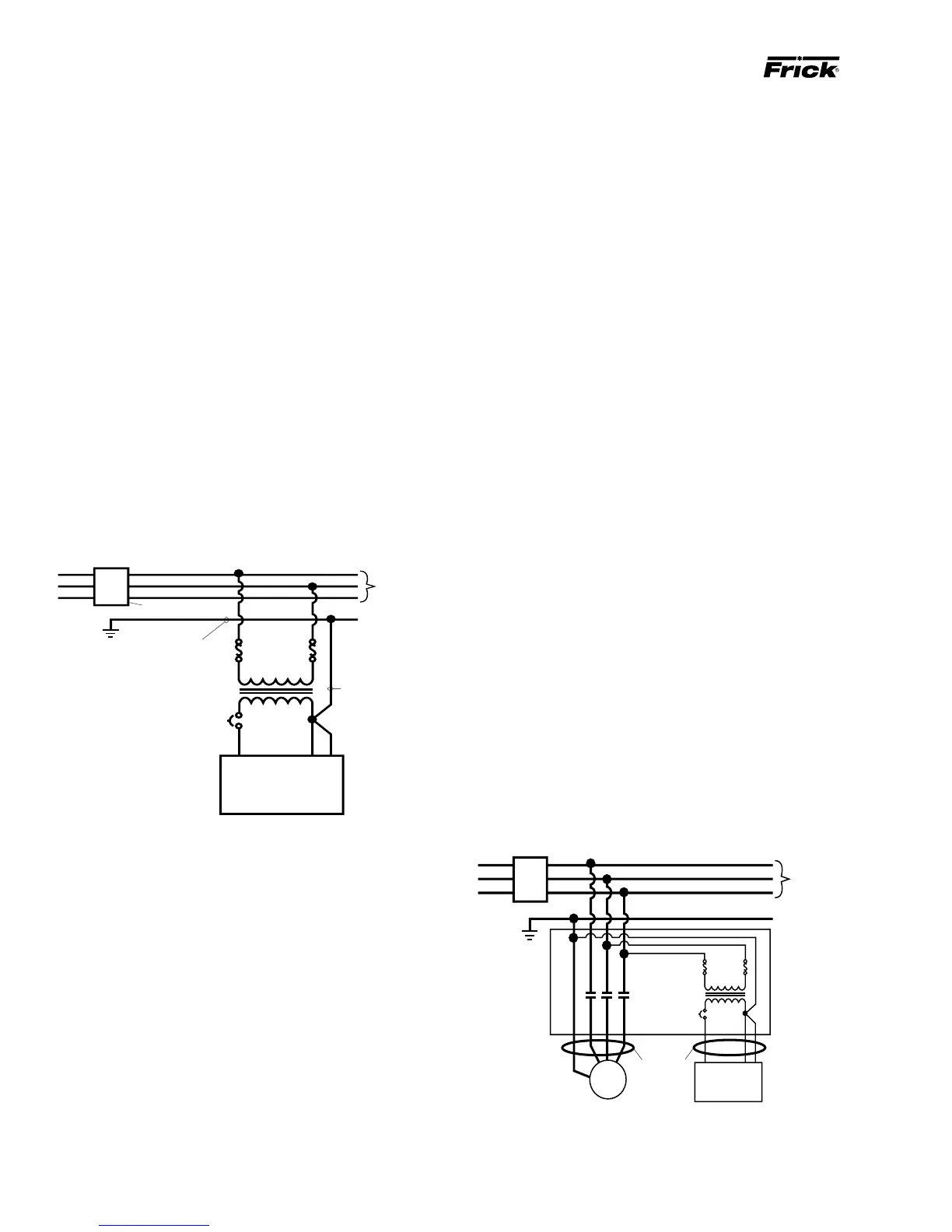
The ground wire must be sized the same size as the
supply wires or one size smaller as a minimum. The
three phase power brought into the plant must also have
a ground wire, making a total of four wires. In many instal-
lations that are having electronic control problems, this es-
sential wire is usually missing. A good ground circuit must
be continuous from the plant source transformer to the elec-
tronic control panel for proper operation. (Figure 2) Driving
a ground stake at the electronic control will cause additional
problems since other equipment in the plant on the same
circuits will ground themselves to the ground stake causing
large ground flow at the electronic equipment.
ALUMINUM
OR COPPER
3-PHASE
BUS
PLANT SUPPLY
TRANSFORMER
COPPER
ELECTRONIC
CONTROL
ART2
Figure 2
WIRING PRACTICES
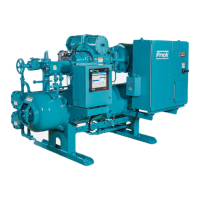
Do not mix wires of different voltages in conduit. An
example of this would be the installation of a screw com-
pressor package. The motor voltage is 480 volts and the
panel control power is 120 volts. The 480 volt circuit must
be run from the motor starter to the motor in its own
conduit. The 120 volt circuit must be run from the mo-
tor starter control transformer to the control panel in its
own separate conduit. If the two circuits are run in the
same conduit, transients on the 480 volt circuit will be in-
ducted into the 120 volt circuit causing functional problems
with the electronic control. Dividers must be used in wire
way systems (conduit trays) to separate unlike voltages. The
same rule applies for 120 volt wires and 220 volt wires. Also,
never run low voltage wires in the same conduit with
120 volt wires. (Figure 3)
Never run any wires through an electronic control panel
that do not relate to the function of the panel. Elec-
tronic control panels should never be used as a junc-
tion box. These wires may be carrying large transients that
will interfere with the operation of the control. An extreme
example of this would be to run the 480 volts from a motor
starter through the control panel to the motor.
When running conduit to an electronic control panel, take
notice of the access holes (knockouts) provided by the manu-
facturer. These holes are strategically placed so that the
field wiring does not interfere with the electronics in the panel.
Never allow field wiring to come in close proximity with
the controller boards since this will almost always cause
problems.
Do not drill a control panel to locate conduit connec-
tions. You are probably not entering the panel where the
manufacturer would like you to since most manufacturers
recommend or provide prepunched conduit connections.
Drilling can cause metal chips to land in the electronics and
create a short circuit. If you must drill the panel, take the
following precautions: First cover the electronics with plas-
tic and tape it to the board with masking or electrical tape.
Second, place masking tape or duct tape on the inside of
the panel where you are going to drill. The tape will catch
most of the chips. Then clean all of the remaining chips from
the panel before removing the protective plastic. It would
be a good idea to call the manufacturer before drilling the
panel to be sure you are entering the panel at the right place.
When routing conduit to the top of an electronic control panel,
condensation must be taken into consideration. Water can
condense in the conduit and run into the panel causing cata-
strophic failure. Route the conduit to the sides or bottom
of the panel and use a conduit drain. If the conduit must
be routed to the top of the panel, use a sealable conduit
fitting which is poured with a sealer after the wires have
been pulled, terminated and the control functions have been
checked. A conduit entering the top of the enclosure must
have an “O” ring-type fitting between the conduit and
the enclosure so that if water gets on top of the enclosure
it cannot run in between the conduit and the enclosure. This
is extremely important in outdoor applications.
480 VOLT
3-PHASE
BUS
GROUND BUS
ELECTRONIC
CONTROL
120 V
480 V
MOTOR
SEPARATE
CONDUIT
MOTOR
STARTER
PANEL
ART3
Figure 3
PROPER INSTALLATION OF ELECTRONIC EQUIPMENT



 To Next Page