Overview of Motor Types
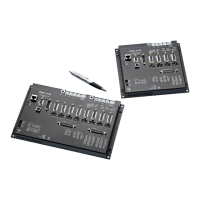
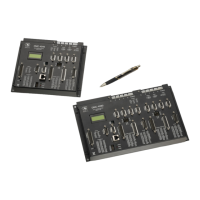
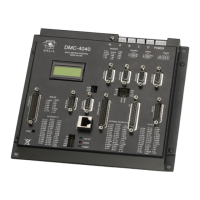
The DMC-41x3 can provide the following types of motor control:
1. Standard servo motors with ±10 volt command signals
2. Step motors with step and direction signals
3. Other actuators such as hydraulics and ceramic motors - For more information, contact Galil.
The user can configure each axis for any combination of motor types, providing maximum flexibility.
Standard Servo Motor with ±10 Volt Command Signal
The DMC-41x3 achieves superior precision through use of a 16-Bit motor command output DAC and a
sophisticated PID filter that features velocity and acceleration feed-forward, an extra pole filter and integration
limits.
The controller is configured by the factory for standard servo motor operation. In this configuration, the controller
provides an analog signal (±10 volts) to connect to a servo amplifier. This connection is described in Chapter 2.
Stepper Motor with Step and Direction Signals
The DMC-41x3 can control stepper motors. In this mode, the controller provides two signals to
connect to the stepper motor: Step and Direction. For stepper motor operation, the controller does
not require an encoder and operates the stepper motor in an open loop fashion. Chapter 2 describes
the proper connection and procedure for using stepper motors.
If encoders are available on the stepper motor, Galil’s Stepper Position Maintenance Mode may be
used for automatic monitoring and correction of the stepper position. See Stepper Position
Maintenance Mode (SPM) in Chapter 6 for more information.
Overview of External Amplifiers
The amplifiers should be suitable for the motor and may be linear or pulse-width-modulated. An amplifier may
have current feedback, voltage feedback or velocity feedback.
Amplifiers in Current Mode
Amplifiers in current mode should accept an analog command signal in the ±10 volt range. The amplifier gain
should be set such that a +10V command will generate the maximum required current. For example, if the motor
peak current is 10A, the amplifier gain should be 1 A/V.
Amplifiers in Velocity Mode
For velocity mode amplifiers, a command signal of 10 volts should run the motor at the maximum required speed.
The velocity gain should be set such that an input signal of 10V runs the motor at the maximum required speed.
Stepper Motor Amplifiers
For step motors, the amplifiers should accept step and direction signals.
Chapter 1 Overview ▫ 6 DMC-41x3 User Manual


 To Next Page