43
(4.13) Looper
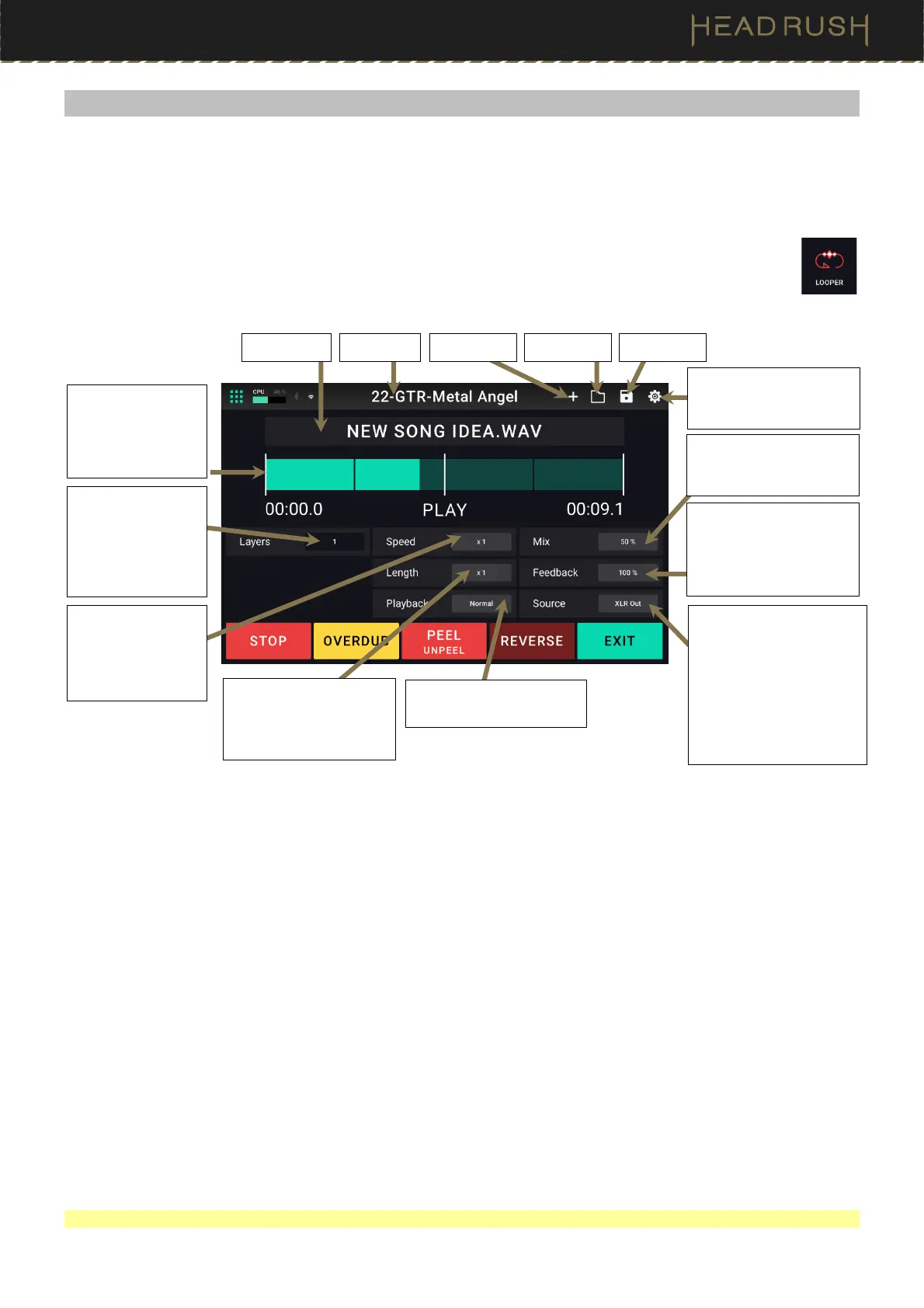
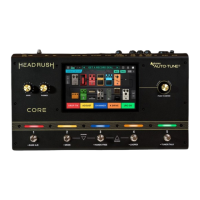
HeadRush Core has a built-in looper that you can use to layer your performances. While the looper’s operation is
shown in the display, you can control most of it conveniently with the footswitches.
Each loop can be up to 5 minutes long, with a maximum of 20 minutes of overdubbed audio at a time across a
maximum of 50 layers.
To access the Looper, tap the Menu icon in the top left of the Main screen, and then tap the Looper
icon. Alternately, press and hold the footswitch 4 (labeled “—Looper”).
To record the first layer of a loop, press the Record footswitch. Recording will begin immediately, and the
footswitch indicator will light red. Press the Record footswitch again to stop recording and start loop playback.
The footswitch is now called Overdub and the footswitch indicator is yellow.
To record additional layers onto the loop (overdub), press the Overdub footswitch. Overdubbing will begin
immediately, and the footswitch indicator will light red. Press the Overdub footswitch again to stop overdubbing
and continue playback.
To erase the top-most (last-added) layer of the loop, press the Peel footswitch. The top-most layer of the loop
will be erased immediately.
To recall the last layer removed, hold the Peel footswitch before performing any overdub actions.
To halve or double the length of the loop, tap the Length field, and turn the encoder. The loop’s relative length
is shown in the Loop Length field. The halving process is non-destructive, so you can restore your original loop
and its content by pressing 2X Loop.
To halve or double the speed of the looper, tap the Speed field, and turn the encoder. The loop’s current relative
speed is shown in the Speed
field.
Tip: Use this to create low bass lines or ultra-high guitar parts that you couldn’t ordinarily play.
Rig name Loop name
Load Loop Save Loop
New Loop
This controls how much
of the looper’s signal you
hear in the outputs.
This controls how much
of the looper’s signal is
routed back through it
when recording another
layer.
Tap here to access
(4.13.1) Additional
Looper Settings.
This meter indicates
your current
location in the loop
during recording or
playback.
This indicates the direction
of playback.
This indicates whether the
looper is located before or
after your signal chain. For
example, moving the
looper to the GUIT IN
position enables you to
edit your guitar rig without
having to play the same
riff over and over again.
This indicates whether
the length of the current
loop has been multiplied
or divided.
This indicates the
current speed of the
loop as a multiple or
fraction of the
original.
This indicates how
many layers are
playing in the
current loop,
including the
original.


 To Next Page