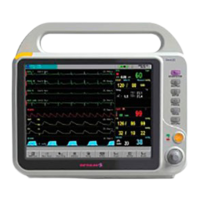
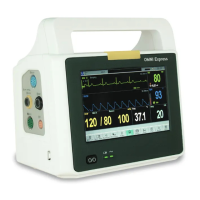
User’s manual of CLEO Patient Monitor
- 22 -
NIBP MONITORING
SUMMARY ON NIBP MONITORING
NIBP CUFF FITTING
NIBP MONITORING INITIALIZATION
NIBP PARAMETER SETUP
NIBP LIST OBSERVATION
MEASUREMENT LIMITATIONS
NIBP ERROR MESSAGES
MAINTAINENCE AND CLEANING
SUMMARY ON NIBP MONITORING
The Non-invasive Blood Pressure (NIBP) module measures the blood pressure using the
oscillometric method.
It can be used on Adult, Pediatric and Neonatal patients.
There are three modes of measurement available: Manual, Automatic and Stat. Each
mode displays the diastolic, systolic and mean blood pressure.
NIBP CUFF FITTING
1. How well the blood pressure cuff fits the patient will influence the accuracy of the
NIBP measurement. The cuff width recommend by the AMERICA HEART SOCIETY is
40% of upper arm circumference or 2/3 of the upper arm length.
2. Apply the blood pressure cuff to the patient’s arm:
Make sure that the cuff is completely deflated.
Apply the appropriate size cuff to the patient, and make sure that the symbol “φ” is
over the appropriate artery. Ensure that the cuff is not wrapped too tightly around the
limb. Excessive tightness may cause discoloration and eventual isocheimal of the
extremities.
3. Make sure that the cuff has not been twisted.
4. Insert the air hose into the NIBP socket on the left panel of monitor. Ensure that the
spring block on the left side of socket has been pressed.
When inserting or unplugging the pipe, otherwise measurement process will be irregular
and the sensor connector will be damaged.
You must not perform NIBP measurements on patients with sickle-cell disease or
any condition under which the skin is damaged or expected to be damaged.
For a thrombasthenia patient, it is important to determine whether measurement of
the blood pressure will be done automatically. This decision should be based on
the clinical evaluation.
Before starting a measurement, verify that you have selected a setting appropriate
for your patient(adult
、
pediatric or neonate). Ensure that the correct setting is
selected when performing measurements on neonate patients, because the higher
adult BP level is not suitable for neonate patients, and it may be dangerous for the
neonate patient to be exposed to high pressure level.
DO NOT apply the cuff to a limb that has an intravenous infusion or catheter in
place. This could cause tissue damage around the catheter when infusion is
slowed or blocked during cuff inflation.



 To Next Page