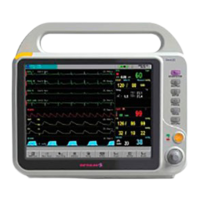
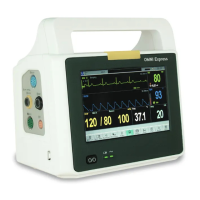
User’s manual of CLEO Patient Monitor
- 37 -
appearance the patient and the sampling line. Replace line if needed.
DO NOT operate the CO
2
Module when it is wet or has exterior condensation.
DO NOT apply excessive tension to any cable.
DO NOT use device on patients that can not tolerate the withdrawal of 50 ml/min +/-
10 ml/min from the airway or patients that can not tolerate the added dead space to
the airway.
DO NOT connect the exhaust tube to the ventilator circuit.
CAUTIONS
DO NOT sterilize or immerse the CO
2
module in liquids.
DO NOT store the CO
2
Module at temperatures less than -40ºF (-40ºC) or greater
than 158ºF (70ºC).
DO NOT operate the CO
2
Module at temperatures less than 32ºF (0ºC) or greater
than 104ºF (40ºC).
DO NOT stick appendage into sample receptacle.
Always insert sample cell before inserting the on-airway adapter into the ventilated
circuit.
Always remove the on-airway adapter from the ventilated circuit before removing the
sample cell.
Nitrous oxide, elevated levels of oxygen, helium, Xenon, halogenated hydrocarbons,
and barometric pressure can influence the CO
2
measurement. Levels to be supplied
by the monitor.
NOTES
The CO
2
module and its accessories are latex free.
After the life cycle of the CO
2
module and its accessories has been met, disposal
should be accomplished following national and/ or local requirements.
ABBREVIATIONS AND TERMINOLOGY
EtCO
2
End tidal carbon dioxide
INSP CO
2
Inspired minimum CO
2
AWRR Air-way respiration rate
BARO Barometric Pressure
ZEROING THE CO2 MODULE
The sample cell zero allows the CO
2
Module to adjust to the optical characteristics of the
sample cell only when requested.
For optimal accuracy, a CO
2
Module zero should be performed whenever the CO
2
Module is connected to the patient monitor.
Before performing a CO
2
Module zero, the CO
2
Module should be removed from the
patient monitor and the airway adapter type to be used in the circuit should be inserted
into the CO
2
Module. Care should be taken ensure that the airway adapter is clear of any
residual CO
2
gas. The maximum elapsed time for a CO
2
Module zero is 30 seconds.
The typical time for a zero is 15 – 20 seconds.
Several CO
2
Module conditions may also request that a zero be performed. These
requests stem from changes in the airway adapter that may indicate that the sensor is not
in optimal measuring condition. When this occurs, the airway adapter should be checked
to ensure optical occlusions such as mucus have not obscured the adapter window. If
occlusions are found, the airway adapter should be cleaned or replaced.
NOTES:
System does not allow adapter zero for 20 seconds after the last breath is detected.
System does not allow adapter zero if temperature is not stable.



 To Next Page