User’s Manual of netMod Network Termination Unit
INTRODUCTION
An Introduction to ISDN
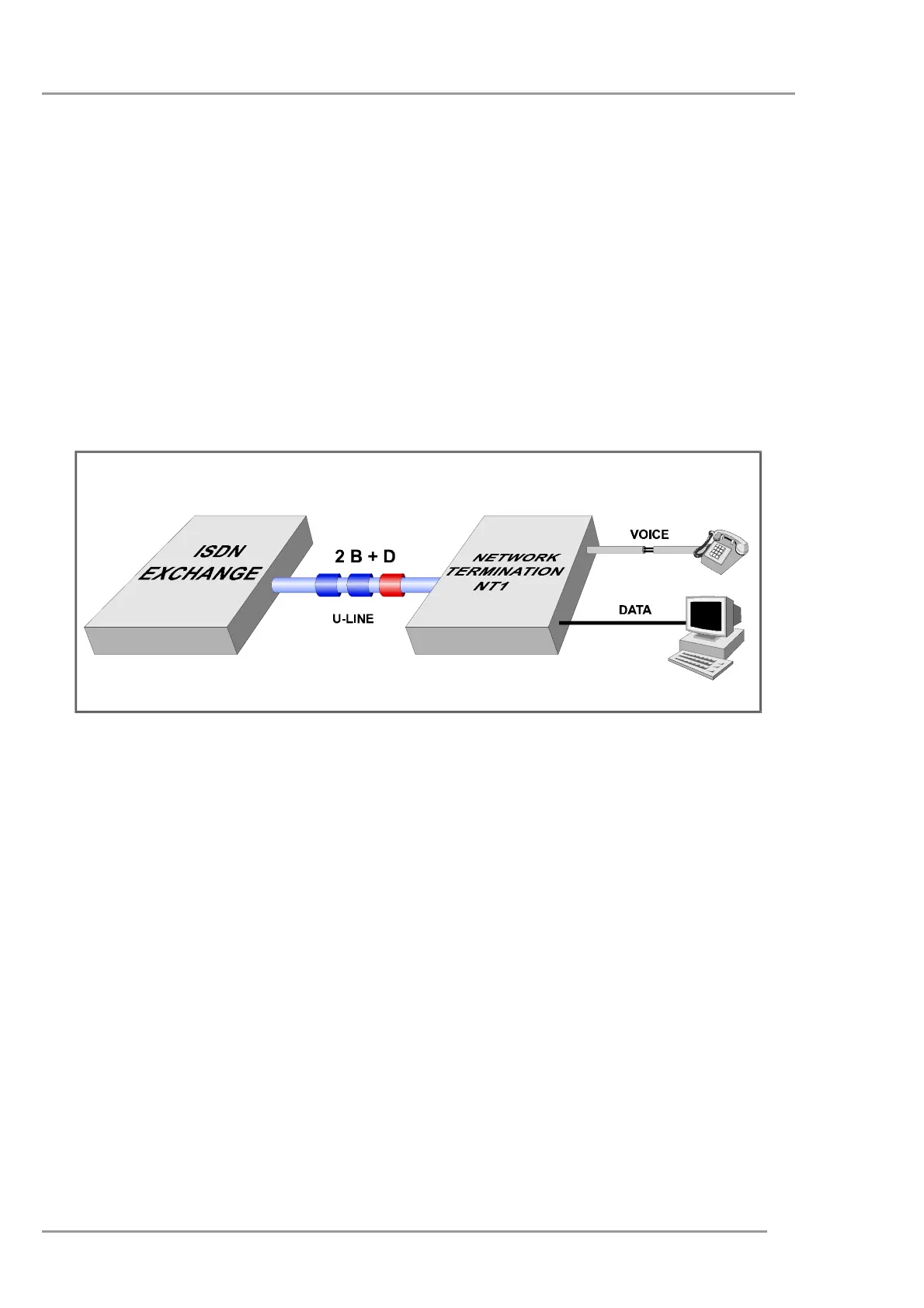
ISDN (Integrated Services Digital Network) is a digital network capable of providing the
end user with high speed data, voice and image transmission at the same time. A way of
accessing the network, is by using the (Basic Rate Access or BRA or 2B+D)
communication protocol which supplies three channels to the subscriber. Two of these
channels are 64kbps channels (B-channels) used for the transmission of voice or / and
data, while the third one is a 16kbps channel (D-channel), used for signalling transmission
between the ISDN Exchange and the Network Termination NT1.
Figure 1: The basic rate access connection (BRA) between the subscriber and the
ISDN network
The connection of a subscriber terminal device to the network requires an intermediate
device, called Network Termination 1 or NT1. The device is installed at the subscriber
side and is connected to the ISDN Exchange via a simple 2-wire line, known as U-line
(Figure 1). The U-line transfers the digital signal that corresponds to the 2B+D channels.
Different types of terminal devices can be connected to the NT1 (ISDN or plain analogue
terminals). In order to cover up the different subscriber’s needs, INTRACOM offers the
following types of Network Termination units:
• netCon
• netCon+
• netMod


 To Next Page