radio control system
EN
Note: every time the transmitter
is switched on, it checks all HF modules and if it detects a fault, it will
not allow the receiver's servo outputs to be activated. This means
that if you disconnect the satellite receiver for the 900MHz band,
you have to also disable the "Enable 900MHz backup" item in the
transmitter "Main menu/Advanced properties/Wireless Mode".
2. Verify that the servos respond to
c o m m a n d s , i . e . t h a t
transmission in the 900 Mhz
backup band is functional.
3. Press the "F1 (antenna icon)"
button to return to dual-band
transmission mode.
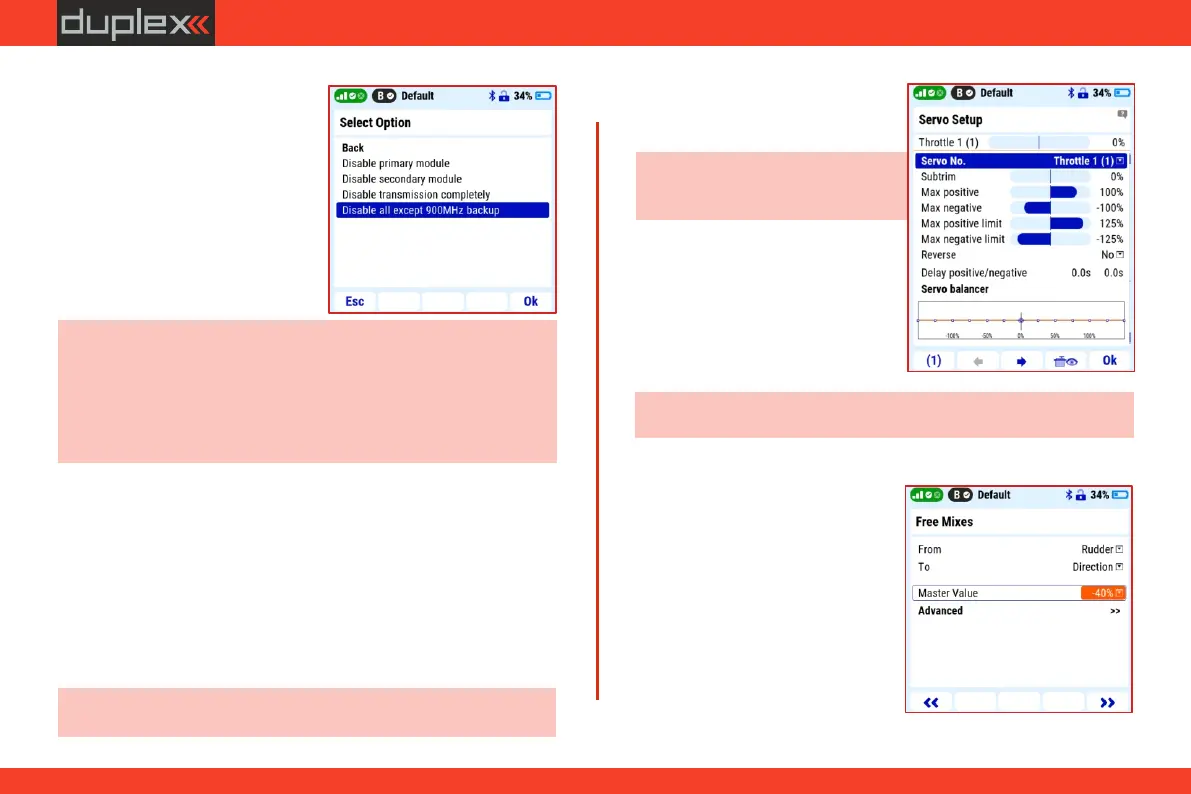
Subtrim: center (neutral) setting of the servo.
3.11.6 Servo setup
Max. positive/negative: setting deflection of the servo at the
max./min. positions of the controller.
Note: this position may be exceeded due to mix, dual rate or trim.
Menu for setting the direction (reverse) and deflections of servos,
neutrals and delay. The current deflection of the selected function is
shown in the upper part of the display, below it is the name of the
function with the number of the receiver's output channel (in
brackets).
Mixes of functions can be created
and set in "Main Menu/Fine
Tuning/Free Mixes". For example,
at the beginning, the "Direction"
function was created to control the
steering of the front landing gear.
In this menu, a mix of functions and
the rudder controller are combined
with the front leg rotation servo.
Note: this deflection will not be
exceeded with any combina-
tion of other function settings.
Delay positive/negative: setting
the time limit for movement
b e t we en m a x/ mi n s e r v o
deflections.
Reverse: setting the reverse
direction of servo rotation.
3.11.7 Free mixes
Note: for the example Cessna 150 model, it is advisable to use this
function to slow down the flaps.
Max. positive/negative limit:
s e t t i n g t h e m a x i m u m
deflection of the servo.
26



 To Next Page