TECHNICAL DESCRIPTION MULTICAL
®
401
5512-091 GB/02.2008/Rev. J1
36
8 The flow part
8.1 Ultrasound with piezoceramics
Manufacturers of flow sensors have been working with alternative techniques to replace the mechanical principle.
Research and development at Kamstrup have proven that ultrasonic measuring is the most viable solution.
Combined with microprocessor technology and piezoceramics, ultrasonic measuring is not only accurate but also
reliable.
8.2 Principles
The size of a piezoceramic element changes when exposed to an electrical field (voltage). When the element is
influenced mechanically, an electric charge is generated. In this way the piezoceramic element can function both
as a sender and as a receiver.
There are two main principles within ultrasonic flow measuring: the transit time method and the Doppler method.
The Doppler method is based on the frequency shifting which is generated when sound is reflected from a moving
particle. This is very similar to the effect you experience when a car drives by. The sound (frequency) is reduced,
when the car passes by.
8.3 The transit time method
The transit time method used in MULTICAL
®
401 utilizes the fact that an ultrasonic signal, that is sent in the
opposite direction of the flow, takes a longer time to travel from the sender to the receiver, than a signal travelling
in the same direction as the flow.
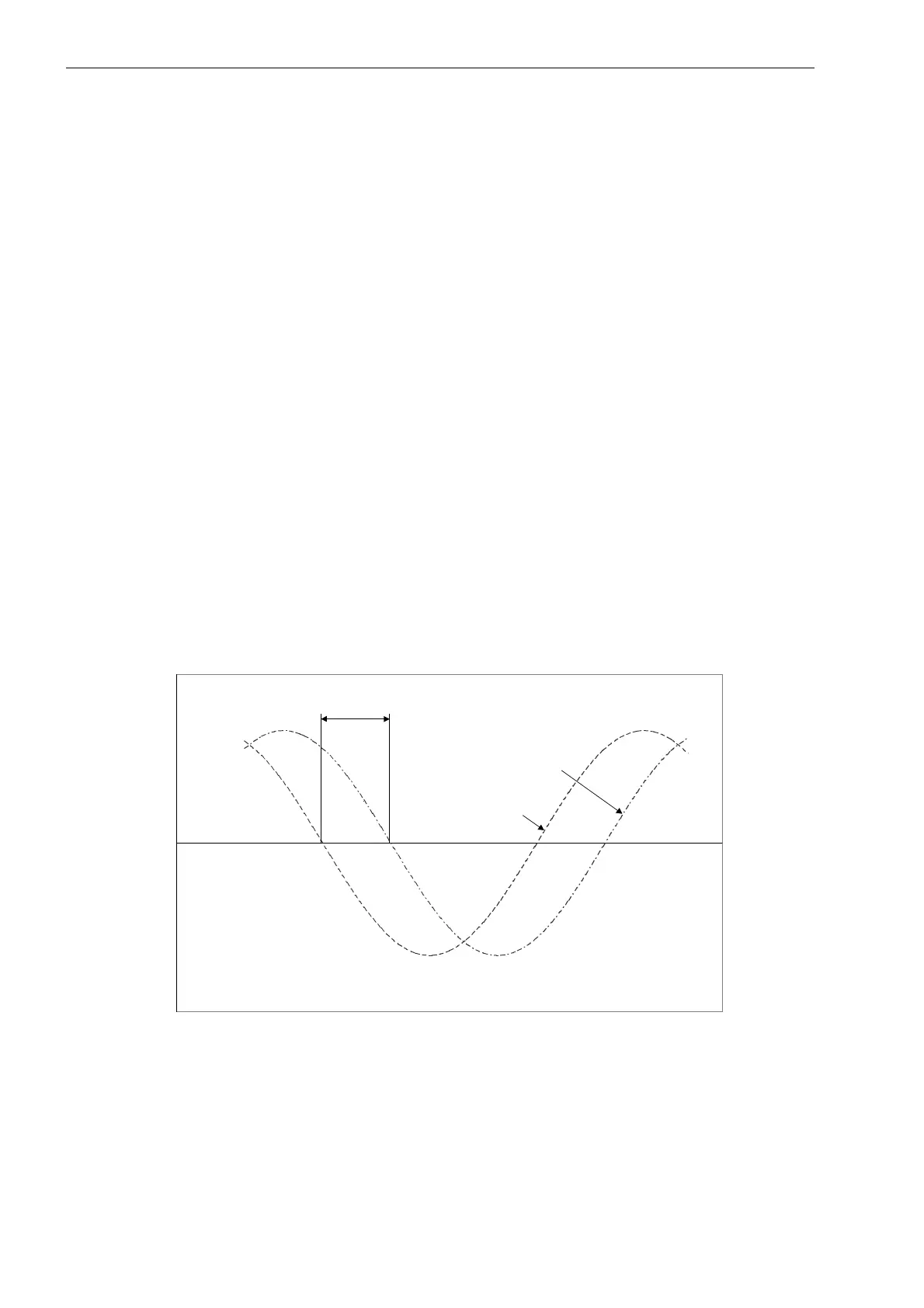
The difference in transit time is very small in a flow sensor (nanoseconds). Therefore, the time difference is
measured as a phase difference between the two 1 MHz sound signals to obtain the necessary accuracy.
PHASE DIFFERENCE
t
SIGNAL
T
Against the
flow
With the flow
Diagram 3





 To Next Page