Chapter - 3 Instrument Description / 3.6 Measurement Principle
13
3.6 Measurement Principle
The polarimeter measures the optical rotation of the orientation of plane-polarized light
caused by optically active substances. In principle, it consists of two polarization filters,
the polarizer and the analyzer, each of which allows only a certain orientation of plane-
polarized light to pass through.
The polarimeter measures the optical activity or the optical rotation of a chemical
substance.
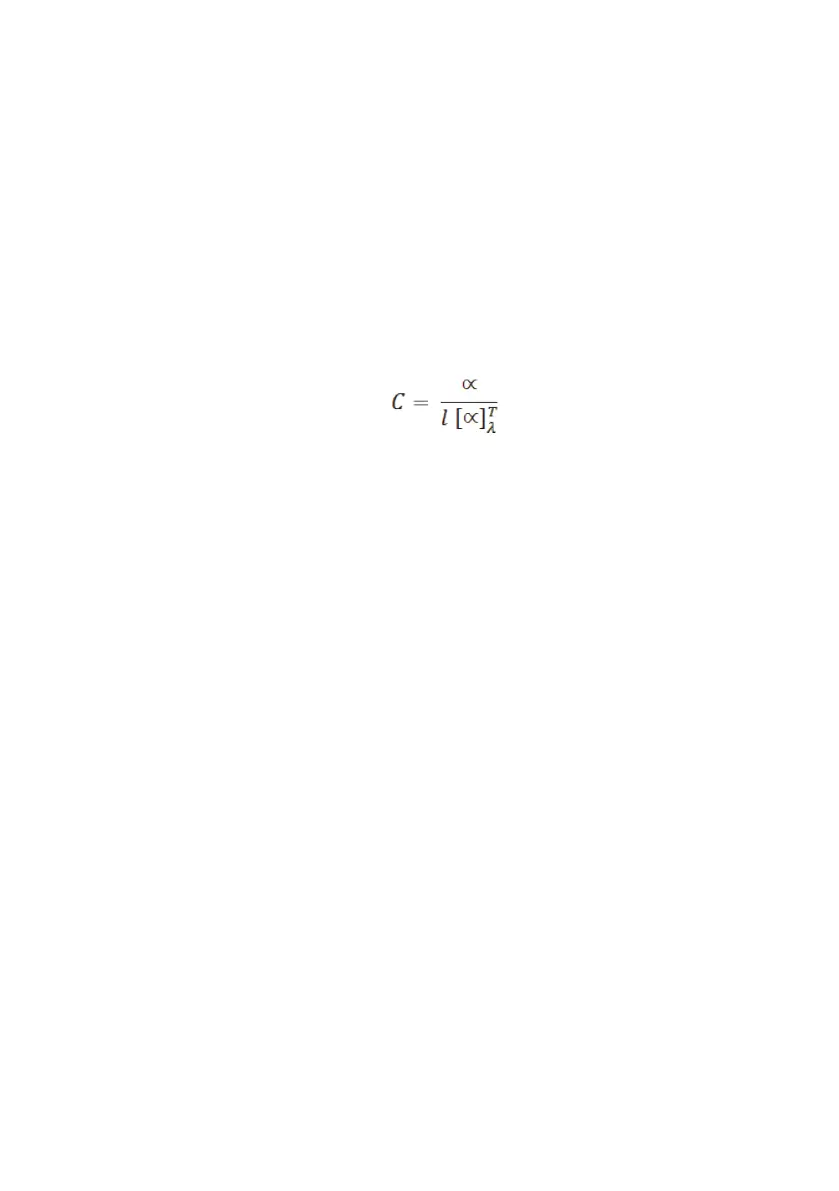
The following equation defines the relation between the optical rotation, the specific
rotation and the sample concentration:
c = concentration [g/l]
α = measured optical rotation [°]
l = tube length [dm]
[α]
T
= specific rotation, dependent on temperature (°C) and wavelength
The optical rotation is, amongst others, dependent on the following parameters:
• Type of sample
• Concentration of the optically active components
• Light wavelength
• Temperature of sample
• Tube length


 To Next Page