PAVER PREPARATION INSTRUCTIONS
To preventcostly downtime,the pavershouldbechecked
thoroughly before each use. Use
the
list belowto assist
in checking the paver.
1. Checkengine
oil
(see enginemanual), hydraulicoil,
gear
box oil
and
diesel fuel.
2.
Referto
Lubrication Charton
page
25 and lubricate
as specified. (Somearea
orweather
conditions may
require extra lubrication).
3. Check hydraulic
hoses,
fittings, pumpsand motors for
leaks, excessive wear
or
damage.
4. Checkthe engine
safety
switch: (the
engine
should
only
start
when
forward/reverse
levers
are
in the
neutral position.) See figure 2.
5.
Checkallelectricalfunctionsbefo~edistributingasphalt.
6. Sprayfuel oil on any part of
the
paver
that comes in
contact with asphalt.
7. Check burner ignition.
STARTING TO PAVE
GENERAL
The paveris capable of placing bituminous base, binder
and surface courses, lime
or
portland cement stabilized
sub-base and graded aggregate materials up to a thick-
ness of 6 inches. The paverhas a production rate of 250
tons
per
hour.
Equipped with electric and manual thickness controls
and a 8' to 13' wide screed,
the
paver
can
handle everythingfrom drivewaysand smallparking lots
to large parking areas and secondary roads.
Before starting to pave,
keep
the
following points in
mind:
A. Plan the project so
that
the
narrowest
passes
are
first, (the basicwidthof the paver) leaving
the
widest
pass until last.
B.
Make
sure to
use
a
reference
guideline.
This
can
be a curb, gutter, adjacent mat
or
a string line. It is
important that the first pass
be straight as it will be
the
guideline
for
the following passes.
Use
the
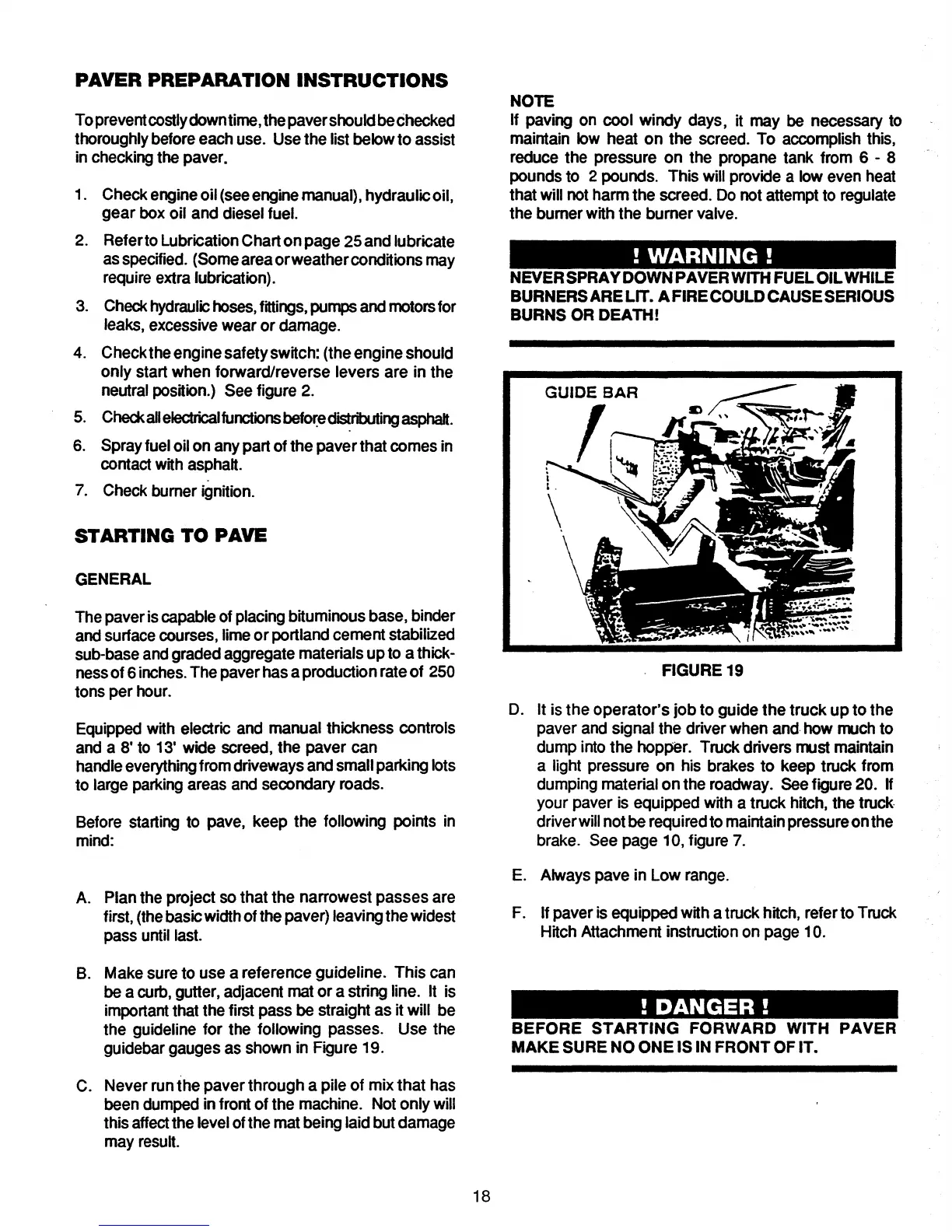
guidebar gauges as shown in Figure 19.
C.
Never
run
the
paver
through
a pile of
mix
that
has
been dumped in front of the machine. Not
only
will
this affect the level of
the
mat being laid but damage
may result.
18
NOTE
If paving on
cool
windy days, it may be necessary to
maintain low heat
on
the
screed. To accomplish this,
reduce
the
pressure
on
the propane tank from 6 - 8
pounds to 2 pounds.
This
will provide a low even heat
that
will not
harm
the
screed. Do not attempt to regUlate
the
bumer
with
the
burner
valve.
!
WARNING!
NEVER
SPRAY
DOWN
PAVERWITH FUEL
OIL
WH"ILE
BURNERSARE
LIT.
AFIRE COULD CAUSESERIOUS
BURNS OR DEATH!
. FIGURE
19
D. It is
the
operator's
job
to
guide
the
truck
up
to
the
paver and signal
the
driver
when
and
how
much to
dump
into
the
hopper. Truck drivers roost maintain
a light pressure on his brakes to keep
truck
from
dumping material
on
the roadway. See figure 20. If
your
paver is equipped with a
truck
hitch, the truck·
driverwill
not
be requiredto maintainpressureon the
brake. See page 10, figure 7.
E. Always pave in
Low
range.
F. If paveris equipped with a truck hitch, referto Truck
Hitch Attachment instruction on page 10.
!
DANGER!
BEFORE
STARTING
FORWARD
WITH
PAVER
MAKE
SURE
NO
ONE
IS IN FRONT OF
IT.



 To Next Page