13 Malfunctions
71
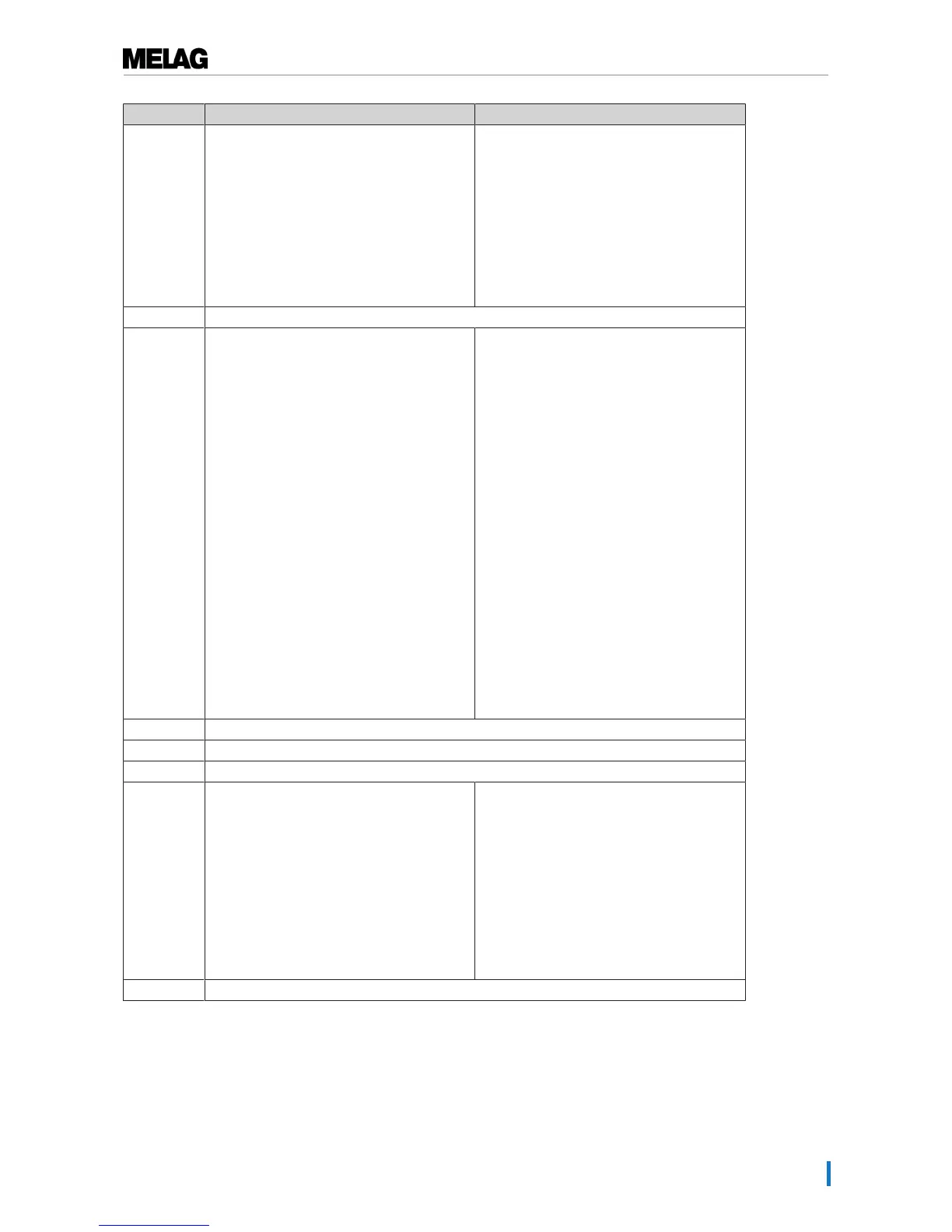
Incident Possible causes What you can do
113 a) The steam sterilizer was switched off at
the power switch during a program run.
b) The power plug has been disconnected or
has not been connected correctly in the
socket.
c) Power outage in the building supply or the
building-side RCD switch has tripped.
a) Never switch off the steam sterilizer at the
power switch during a program run.
b) Check whether the power plug is
connected, the power cable has suffered
damage or a loose contact or loose plug
connections is the cause. Plug the power
plug back into the mains socket.
c) Arrange for an inspection of the building-
side installation (e.g. automatic circuit
breaker) and test the steam sterilizer at
another socket or on another circuit.
114 see event 78
124 a) The surrounding temperature of the steam
sterilizer is too hot.
b) The minimum clearance to the
surrounding surfaces has not been
maintained. The steam sterilizer receives no
or insufficient cooling air.
c) The steam sterilizer is overloaded.
d) The steam sterilizer was operated without
an insert rack and the load (especially the
textiles) comes into direct contact with the
chamber wall.
e) The openings for suction of the cooling air
on the underside of the steam sterilizer are
covered.
f) The chamber filter “Vacuum” is soiled/
blocked.
a) The ambient temperature must be below
40 °C. We recommend a maximum
temperature of 25 °C.
b) Maintain a minimum clearance to the
surrounding surfaces (see information in the
technical manual).
c) Comply with the maximum permissible
load quantities (see Selecting the program
[}page 26]). If necessary, perform a vacuum
test.
d) Always operate the steam sterilizer with
an insert rack and comply with the loading
information (see Loading the steam sterilizer
[}page 22]).
e) Check whether the cooling air suction
openings in the underside of the steam
sterilizer are covered and remove any
objects obscuring them e.g. paper or
packaging.
f) Remove the "Vacuum” chamber filter (in
the rear area of the sterilization chamber
below) and check whether it is e.g. soiled/
blocked by packaging. If necessary, clean
the chamber filter.
125 see event 124
126 see event 124
127 see event 124
131 a) The waste water hose is kinked or
installed sagging.
b) The siphon is blocked or the waste water
line is impeded on the building side.
c) Multiple devices have been connected to a
single siphon and imped each other during
water discharge.
d) The chamber filter "Pressure release" is
blocked.
a) Check the installation of the waste water
hose. This must be installed without kinking
or sagging and at a constant decline.
b) Check whether the building siphon or the
waste water line is are blocked.
c) If multiple devices are operated
simultaneously, we recommend the
installation of an additional siphon.
d) Remove the "Pressure release” chamber
filter and check whether it is soiled/blocked
by packaging If necessary, clean the
chamber filter.
133 see event 124



 To Next Page