8 Vehicle Towing Instructions
54
Meritor Maintenance Manual MM-15103 (Issued 07-17)
8 Veh icle Tow ing Ins tructi ons
Hazard Alert Messages
Read and observe all Warning and Caution hazard alert messages in
this publication. They provide information that can help prevent
serious personal injury, damage to components, or both.
To prevent serious eye injury, always wear safe eye protection
when you perform vehicle maintenance or service.
When transporting a vehicle with the wheels of one or both drive
axles on the road, it is possible to damage the axles if the wrong
procedure is used before transporting begins. Meritor recommends
that you use the following procedure.
Before Towing or Drive-Away
Engage the parking brake to prevent the vehicle from moving
before you begin maintenance or service procedures that
require you to be under the vehicle. Serious personal injury
can result.
1. Apply the vehicle parking brakes using the switch inside the
cab of the vehicle.
NOTE: Remove both axle shafts from the axle(s) that will remain on
the road when the vehicle is transported.
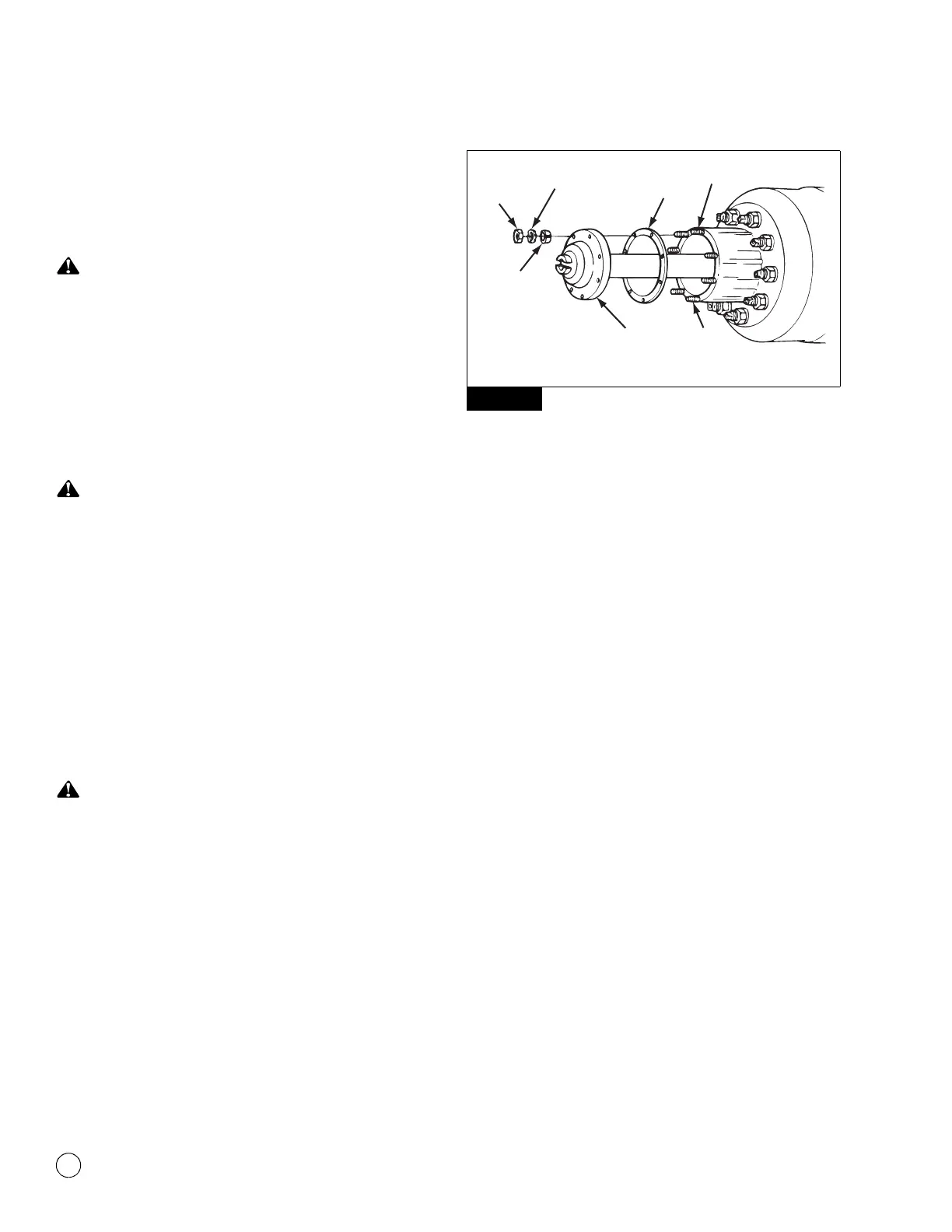
2. Remove the stud nuts and washers from the flange of the axle
shafts. Figure 8.1.
Do not use a chisel or wedge to loosen the axle shaft and
tapered dowels. Using a chisel or wedge can result in damage
to the axle shaft, the gasket and seal, and the axle hub.
3. Loosen the tapered dowels, if used, in the flange of the axle
shaft. Refer to Section 3 and Figure 8.1.
Figure 8.1
4. Identify each axle shaft that is removed from the axle assembly
so they can be installed in the same location after transporting
or repair is completed. Example: Match mark a mating axle
shaft and hub.
5. Remove the tapered dowels, gasket, if used, and the axle shaft
from the axle assembly. Figure 8.1.
6. Install a cover over the open end of each hub where an axle
shaft was removed. This will prevent dirt from entering the
bearing cavity and loss of lubricant.
NOTE: If an air supply will be used for the brake system of the
transported vehicle, continue with Step 7 and Step 8, otherwise
continue with Step 9.
7. Connect an auxiliary air supply to the brake system of the
vehicle that is being transported. Before moving the vehicle,
charge the brake system with the correct amount of air
pressure to operate the brakes. Refer to the instructions
supplied by the vehicle manufacturer for procedures and
specifications. If an auxiliary air supply is not used, continue
with Step 9.
8. When the correct amount of air pressure is in the brake
system, release the parking brakes of the vehicle that is being
transported. Step 9 is not required.
Figure 8.1
1002581c
TAPERED
DOWEL,
IF EQUIPPED
GASKET
STUD
SHAFT
HUB
AXLE
AXLE
SHAFT OR
FLANGE
STUD
NUT
WASHER



 To Next Page