Temperature Control Units : MFC with G Series Instrument
Page: 79
Milacron Process Support Business
4165 Halfacre Road Batavia, Ohio 45103
Phone: 513-536-2584
www.milacron.com
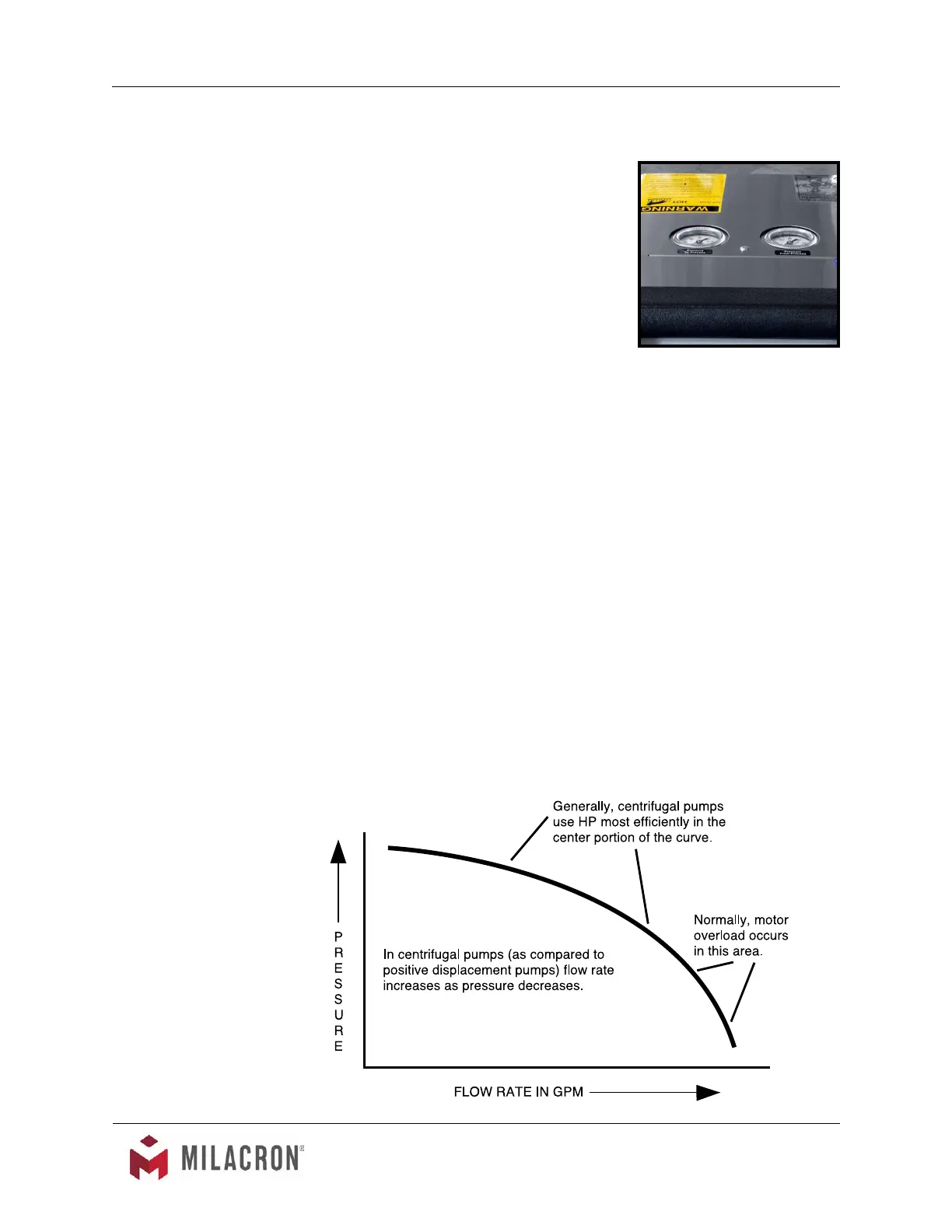
8.2 INTERPRETATION OF PROCESS PRESSURE GAUGES
A. READ AVAILABLE WATER PRESSURE AT UNIT’S
LOCATION. When a temperature control unit is attached
to the process with the water supply on and the pump
off, both gauges will read the water supply pressure at
the unit’s location.
B. READ PRESSURE DROP ACROSS PROCESS (∆ P).
With the pump on, the “to process” pressure gauge will
rise to read the sum of the water supply pressure and
pump generated pressure. The “from process” pressure
gauge reads the effect of water supply pressure and
pump suction pressure. The difference between the
to and from process gauges is the pump generated circulating pressure... which is also
equal to the pressure drop across the process.
C. PUMP ROTATION INDICATION. If the pump is running, and both gauges are “close” to
same value, it is likely that the pump is rotating backward, or the pump is generating such
a high ow that an overload condition will result.
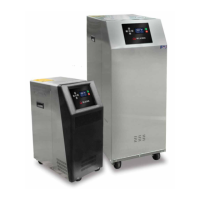
D. PUMP MOTOR OVERLOAD CONDITION. If the ∆ P is low with the pump rotating
correctly, then the ow rate is high, which probably will result in a motor overload. Refer
to the representative pump curve below.
E. WATER HAMMER (COMPETITIVE SOLENOID VALVE UNITS). On competitive mold
temperature controllers, when ∆ P gauges are supplied, the water hammer effect of on/off
solenoid valves can be seen. When the solenoid valve is open, both to and from process
pressure gauges will fall as the system depressurizes. When the valve closes, there will
be a momentary spike that will be seen on both pressure gauges, then they will settle
back to normal ∆ P values. This spike is called “water hammer”.
Pressure gauges



 To Next Page