• Stratum 3 clock
Optional Configuration
You can add
• Dual or Quad DSP modules for G.729a compression
• DSP II module for FAX Relay (T.38) and/or G.729.a compression
• One or two T1/E1 Combo cards
• One or two Quad BRI Framer modules
• Analog Option Board for additional analog trunks and lines
• APC-CX(i) processor for running supported applications.
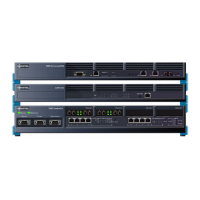
CX II and CXi II Controllers
The CX(i) II controllers are next-generation versions of the original CX and CXi controllers.
Featuring increased processing power, the CX(i) II can support up to 150 users and with fewer
limitations on resource (DSP) intensive applications. In fact, the base configuration of the CX(i) II
has all the DSP resources the system requires. You only need to add more DSP resources for
enhanced functionality—for example, T.38 fax support—not performance scaling. For more
information on resource-related improvements to the CX(i) II, see the “Engineering Guideline
Updates” on page 14. Other key enhancements of and CX(i) II include:
• choice of an 8 GB solid state (Flash) drive or a 80 GB spinning drive for mass storage media.
• two 21363 DSPs on the main board providing sufficient resources to support main telephony
functions (tone generation, tone detection, voice mail, record a call, 30-party conference)
and 32 channels of Echo cancellation.
• support for the new Application Processor Card (APC) which offers additional deployment
options for Mitel Applications Suite (MAS) solutions.
• redundant fans
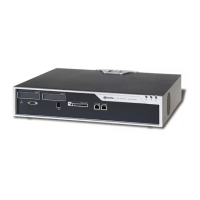
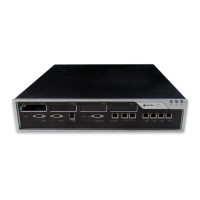
The CX(i) II controller front panel consists of the following components:
• Three slots for expansion modules
• DB-9 RS-232 Maintenance Console Port used to access the operating system shell. Also
supports hardware flow control for an external modem. All other directed I/O function such
as the virtual printer port and embedded CPU serial port are accessed through either secure
telnet or a TCP/IP socket.
• Dual USB 2.0 ports (for future use)
• CX II only; 10/100 BaseT LAN port (RJ-45 connector)
• CXi II only; 10/100 BaseT WAN port (RJ-45 connector) with built-in firewall
The WAN port and firewall is intended to be used either as an access point for performing
remote diagnostics and maintenance (similar to a MODEM) or, if the Firewall function is





 To Next Page