Hardware Technical Reference Manual
• Table 26, “Brazil: LS Trunk Impedance Values,” on page 53
• Table 32, “UK: LS Trunk Impedance Values,” on page 57
ASU LS Trunk Parameters
LS Trunk Transmission Parameters – Recommendations for Trunk Descriptor Settings
For best performance, analog trunks to the local exchange or Central Office should operate
with an attenuation in the range of 0 dB to -8 dB. Higher attenuation will degrade the signal
(both acoustic and DTMF dialing) and may make some connections, such as long distance,
difficult to use. Short loops provide the best performance.
The following trunk descriptors are recommended based on the amount of attenuation
presented:
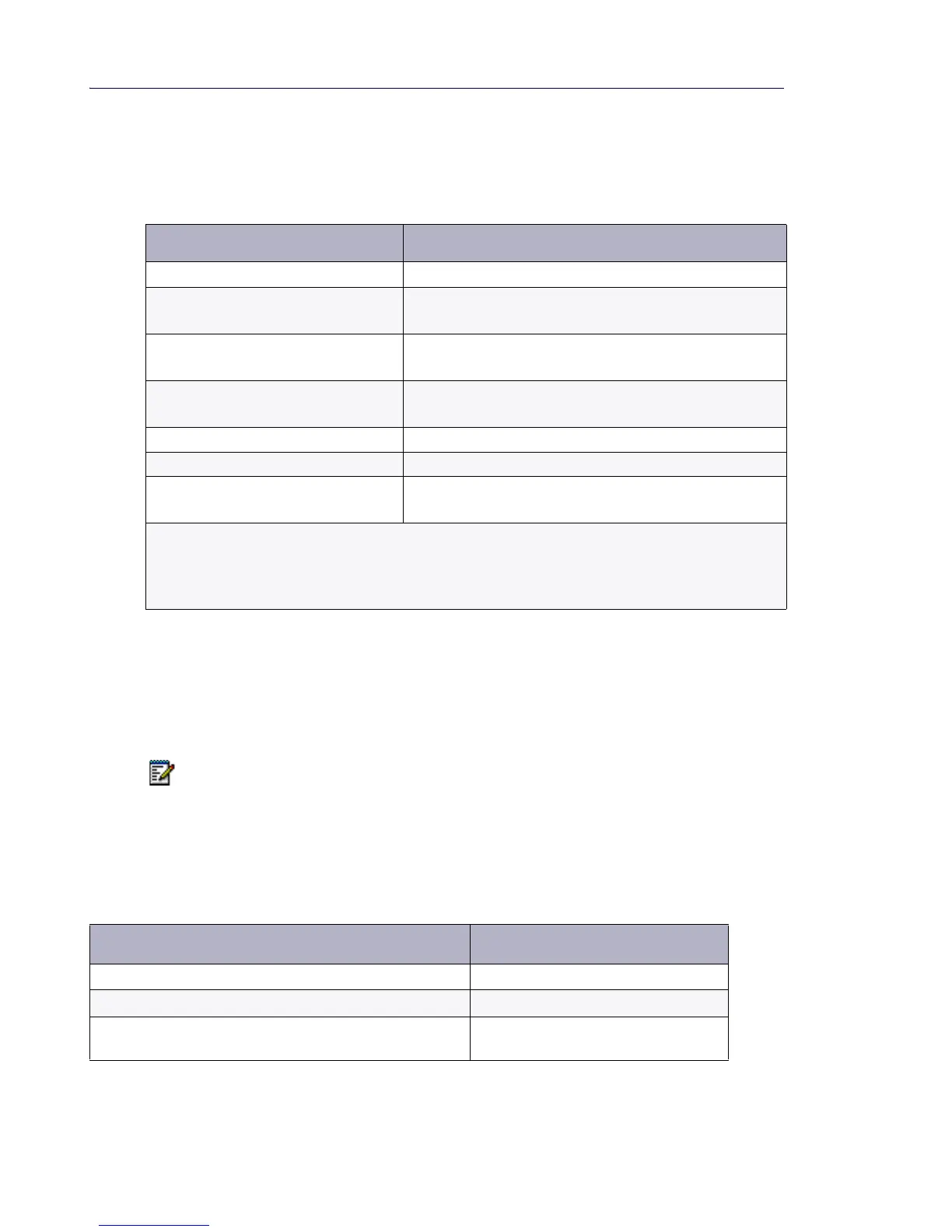
Trunk Functions Parameters
Min. operating loop current 18 mA
Max operating loop current 100 mA (NA/LA)
60 mA (UK/EU)
Loop current limit None (NA/LA)
60 mA (UK/EU)
Ring detector threshold 30 Vrms (NA/LA)
20 Vrms (UK/EU)
Reversal detector Detects CO battery polarity
Loop-detect for CO disc. (no battery) < 2V across Tip and Ring
Meter Pulse Detection None (NA/LA/EU)
50 Hz longitudinal (UK)
Notes: The NA variant is designed according to the performance standard EIA/TIA 464C.
The UK Variant is designed in accordance with CTR21, but has design parameters favoring BS6305
and BS6450.
The EU variant is designed in accordance with CTR21.
Note: (North America only) The AMB/AOB and ASU II LS trunk interface support a special
Trunk Category that may alleviate issues when using Trunks that present more than -8
dB of attenuation. For details see Table 21, “Attenuation Levels for Short and Long CO
Trunks,” on page 51.
Table 63: Attenuation Levels for Short and Long CO Trunks
Trunk Category (CO Trunk Circuit Descriptor form) Attenuation on Trunk Line
Short 0 dB to -3 dB
Long -3 dB to -6 dB
Long (some additional signal loss will occur with lines of
this length)
-6 dB to -8 dB
Caution: Near maximum attenuation





 To Next Page