Hardware Technical Reference Manual
The 16 ports comply with the 802.3af Power over Ethernet specification, which enables them
to deliver power to IP phones and other Ethernet devices over Category 3 or 5 cabling. As a
minimum, the PoE module provides enough power for 16 IP phones, some of which may be
fitted with PKMs. For details about PoE and planning a PoE installation, see the Engineering
Guidelines on the Mitel Edocs web site (http://edocs.mitel.com).
The internal switch uses 802.1p/Q VLAN prioritization to ensure the quality of voice calls,
forwarding packets with priority value 6 (from IP phones) ahead of packets with priority value 0
(from PCs and other IP devices). Programming is required only if an expansion switch is
connected. Refer to the CX/CXi-Specific Guidelines in the Engineering Guidelines document.
Features
• Managed switch functions: support for 802.1p/Q prioritization on default VLAN (1)
• Auto-MDIX: automatically adjusts for straight-through or crossover cables on all ports
• Port speed auto negotiation: the port will negotiate with the far end device to select 10Base-T
or 100Base-TX transmission rates and half or full duplex (or manually programmable)
• Flow control: ensures reliable communication during full-duplex operation
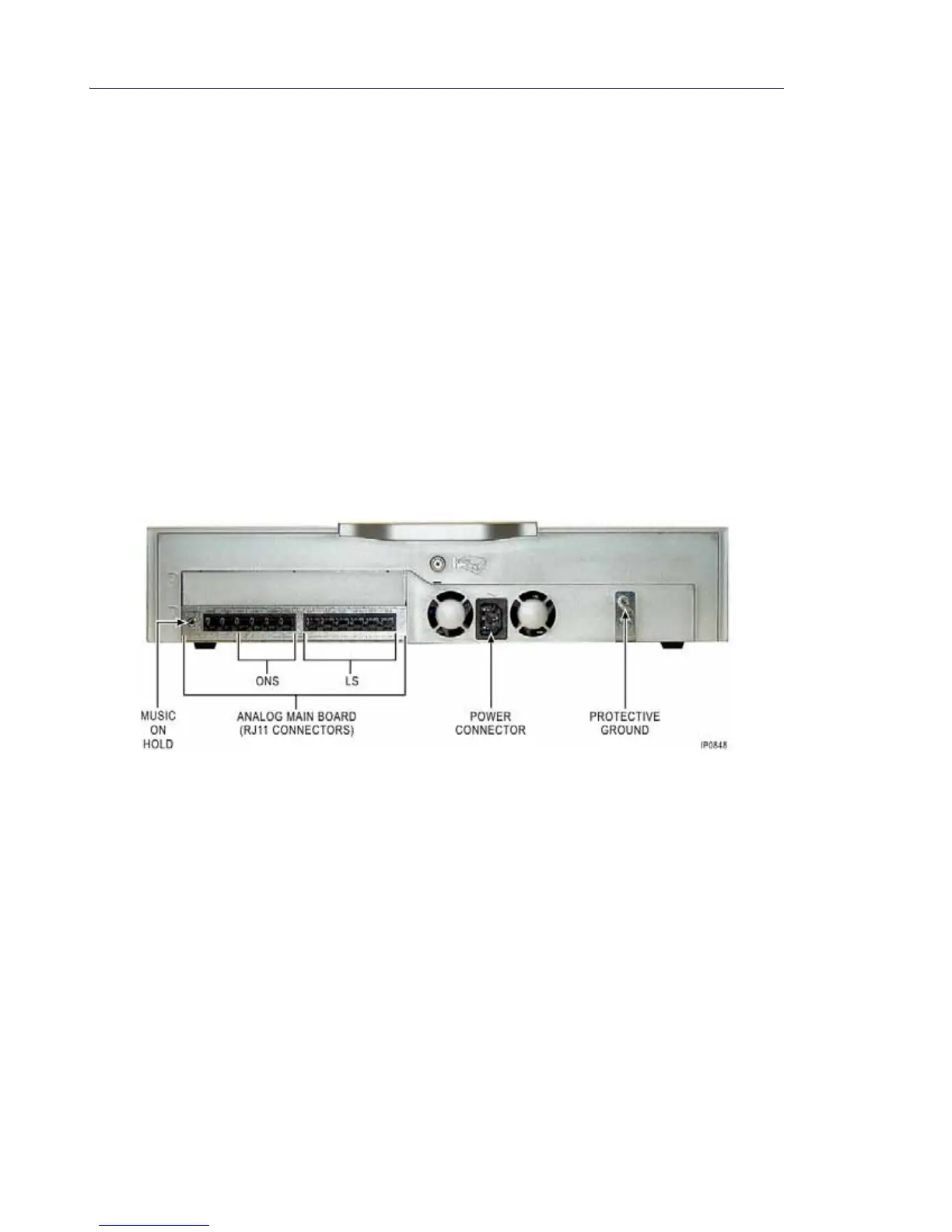
Figure 11: CX/CXi - Rear View
The Controller rear panel consists of the following components:
• Input power connector (standard male IEC320 AC)
• Protective ground
• Analog Main Board (AMB). Includes 6 LS CLASS trunk ports (for North American and Latin
America), 4 ONS ports, a single Music-on-Hold port (1 source supported), a single Paging
port (1 paging zone), and two System Fail Transfer circuits
• Analog Option Board (optional).
Standard Configuration for CX and CXi
• One 266 MHz processor
• 512 MB of RAM on the mid-plane
• Analog Main Board





 To Next Page