System
33
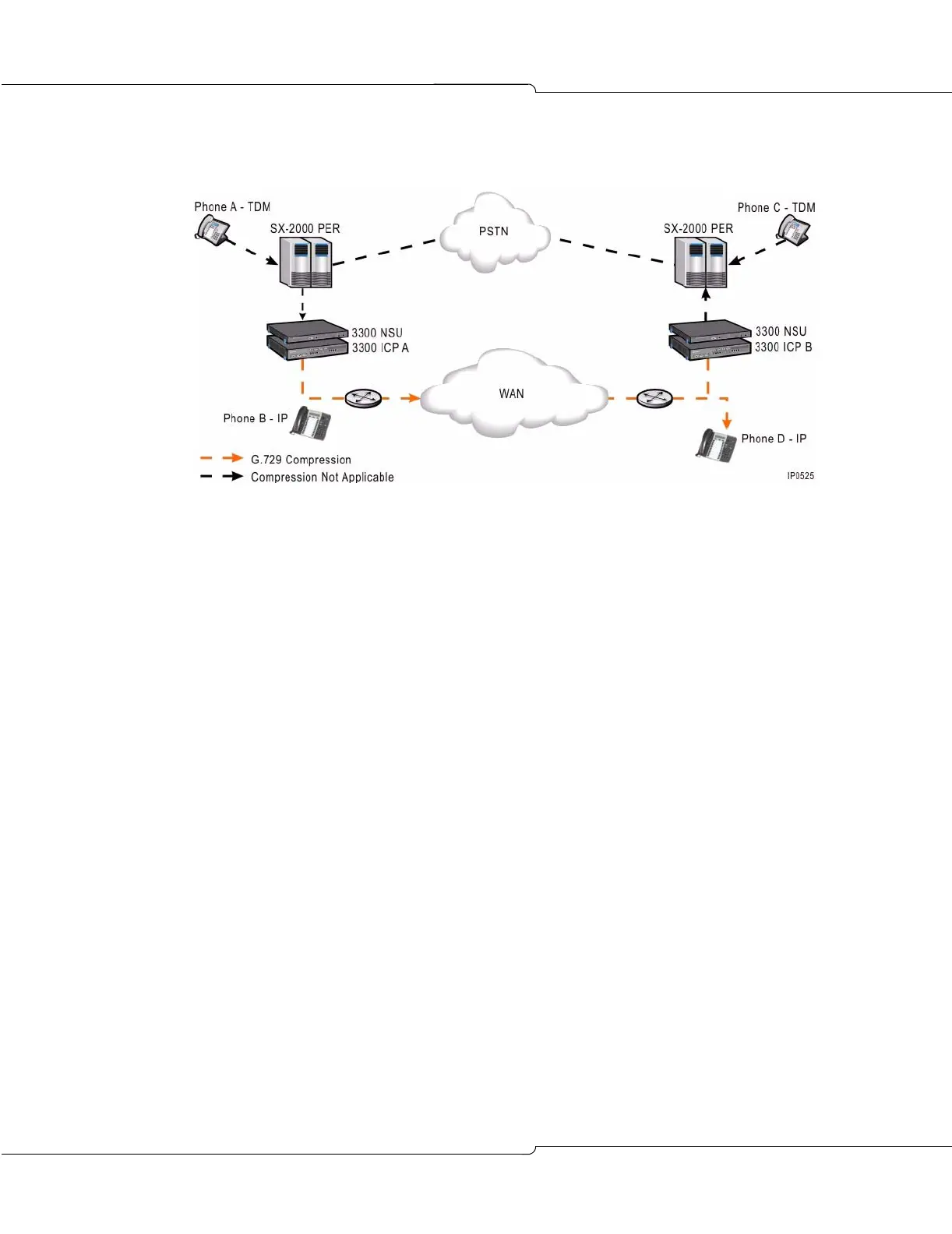
Optional compression licenses and DSP modules can be purchased to enable TDM to IP
compression on the 3300 ICP.
Resiliency
Reliability of communication systems is a critical requirement for business. To meet this need,
Mitel provides resiliency with the 3300 ICP. Resiliency on the 3300 ICP increases
communications reliability by maintaining calls in progress, handling new incoming and outgoing
calls, and continuing to provide voice mail services in the event of 3300 ICP or network failure.
This provides a higher grade of service to users as well as flexibility of deployment, thus
increasing addressable market and competitive edge.
Using self-healing techniques that take advantage of IP-network characteristics of location
independence, resiliency provides an extremely flexible solution to enhance system reliability.
By being able to take advantage of resources spread across the network, resiliency ensures
that there is no single point of failure and that hardware resource utilization is optimized.
Resiliency provides an obvious advantage over many other competitive implementations,
where the only option is costly hardware redundancy for every controller.
The 3300 ICP Resiliency solution provides:
• Device resiliency - An alternate or secondary ICP provides service to phones in the event
of a failure on the home or primary ICP or in the event of a networking failure between the
phone and the primary ICP. The secondary ICP directs phones to transfer back to the
primary ICP once the failure is corrected. In Release 7.0, the MXe supports redundancy
with the addition of a RAID controller and two hard disks, and a second AC PSU.
• Trunk resiliency - In Release 7.0, the new T1/E1 Combo Mitel Mezzanine Card (MMC)
supports T1/E1 trunk resiliency.
• Call resilience - Calls in progress over the IP infrastructure are maintained.
• Voice Mail resiliency - Embedded voice mail continues to be provided to a device when
it moves to a secondary ICP during failure.





 To Next Page