Need help?
Do you have a question about the MKS 640B and is the answer not in the manual?
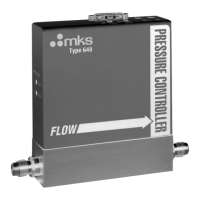
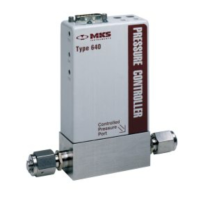
The MKS Type 640B/641B Pressure Controller is a sophisticated, RoHS-compliant device designed for precise pressure control in various applications. It integrates a Baratron® capacitance manometer (available in absolute or gage pressure versions), a normally closed proportional control valve, and closed-loop control electronics. This compact unit, with a small three-inch footprint, is capable of functioning as a proportional-integral (PI) controller.
The primary function of the MKS Type 640B/641B is to accurately control pressure within a system. It achieves this by comparing the actual pressure reading from its transducer to a user-defined set point. Based on this comparison, the controller adjusts the position of its proportional control valve to maintain or achieve the desired pressure. The unit can be configured for either upstream or downstream pressure control applications. In downstream control, the controller is positioned before the controlled pressure volume and regulates the gas entering the system. In upstream control, it is positioned after the controlled pressure volume, and gas enters the controller on the transducer side.
The controller offers two user-settable alarm trip points, Trip Point A and Trip Point B, which can be configured from 1% to 100% of full-scale. Each trip point controls an open collector transistor and has an associated LED indicator on the top of the unit to show its status. These trip points can be used to control external relays or equipment, or as digital inputs to a computer, providing enhanced process control and safety.
The MKS Type 640B/641B is designed for ease of installation and operation. It can be mounted in any orientation, though an upright position is recommended. The "Controlled Pressure Port" label clearly indicates the transducer inlet, ensuring correct system integration.
Initial Configuration: The unit ships from the factory configured for downstream pressure control, with a 0 to 5 V set point input and pressure output, and specific initial settings for trip points and PI terms. Users can reconfigure these settings as needed.
Pressure Control: The controller can operate in closed-loop control mode, comparing the pressure signal from its transducer (or an optional external sensor via pin 10) to the set point. Valve Close and Valve Open commands have the highest priority, allowing immediate override of other operations. A "Set Point Recognition Operating Mode" is also available, where the valve moves to a fully closed (downstream) or fully open (upstream) position if the set point signal falls below 1% of full-scale.
Tuning: The Proportional (P) and Integral (I) terms can be adjusted via dials on the top of the unit to optimize the controller's response to pressure changes. A higher P term generally leads to a faster response but can cause oscillation if too high. The I term helps reduce error to zero over time; increasing its setting shortens the integration time, leading to a quicker response.
Zero and Span Adjustment: The transducer zero can be checked and reset periodically using a potentiometer on the top cover. For absolute transducers (Type 640B), zeroing requires the unit to be pumped down to a pressure less than the transducer's resolution. For gage transducers (Type 641B), the process port must be open to atmospheric pressure. Span adjustment should only be performed in conjunction with a calibration transfer standard.
Trip Points: Two alarm trip points (A and B) are adjustable from 1% to 100% of full-scale via pots on the top cover. Test jacks on the side allow for measuring the trip point voltage (0 to 5 V). The action of each trip point (trip high or trip low) can be changed by repositioning jumpers on the Transducer board. These are useful for error indication or controlling other equipment.
Interface: The unit features a 15-pin, male Type "D" connector for pressure output, set point input, and trip point output signals. An optional input pin (pin 10) allows for re-introducing a corrected pressure signal, overriding the internal transducer signal for closed-loop control.
Valve Orifice Selection: The controller is available with seven different valve orifice sizes, which determine the nominal flow rate range. Users should verify that the installed orifice size is appropriate for their application, especially when using gases other than nitrogen, by calculating an orifice sizing factor based on gas density.
The proportional control valve is not a positive shutoff valve, and some leakage may occur. Depending on the application, a separate positive shutoff valve may be required in the system. Users must also ensure that the system can withstand pressures up to the transducer's full-scale range and avoid exposing the transducer to pressures exceeding 45 psia or twice the full-scale pressure (whichever is greater) to prevent damage. When operating with hazardous materials, users are responsible for observing proper safety precautions, purging the instrument, and ensuring material compatibility. The instrument should not be operated in an explosive environment unless specifically certified.
 General
| Brand | MKS |
|---|---|
| Model | 640B |
| Category | Controller |
| Language | English |

 To Next Page