How To Chan
e the Pressure Output Si
nal Ran
e Chapter Four: Operation
48
How To Change the Pressure Output Signal Range
The pressure output signal can be a 0 to 5 Volt (initial setting) or 0 to 10 Volt signal. To change
the range of the pressure output signal, and therefore, the set point input, you must remove the
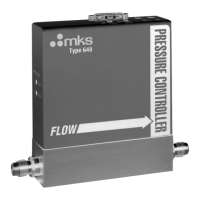
cover of the 640B pressure controller and reposition two jumpers on the Transducer board.
Note
The range of the pressure output signal determines the range used for the
set point input signal. The initial configuration is for a 0 to 5 Volt
ressure output signal. Therefore, a set point input signal of 5 Volts is
equal to 100% of full-scale. If you change the range of the pressure
output signal to 0 to 10 Volts, a 5 Volt set point signal would be 50% of
full-scale.
1. Stop the gas flow through the 640B pressure controller.
2.
Remove the power supply and any other leads or wires attached to the connector on the
640B controller.
3.
Use a
3
/16” hex wrench (or open-ended wrench) to remove the hex nuts on each side of the
I/O connector. Remove the 4 Phillips head screws from the sides of the enclosure.
4.
Refer to Figure 3, page 17, for the location of the hex nuts on the I/O connector. Place
the hex nuts and screws aside for safe keeping.
5.
Position the controller with the front side facing you, and pull up on the enclosure to
remove it.
The MKS logo is displayed on the front of the unit. The board assembly will be visible,
with the Transducer board facing you. The Control board is connected to the back of the
Transducer board.
6.
Locate the jumper block labeled “JP2” on the right-hand side of the Transducer board.
7.
Refer to Figure 20Error! Reference source not found., page 45, for the location of the
“JP2” jumper block.
8.
Position the jumper vertically, according to the silk-screening on the board.
Position the jumper on the right-hand side for 0 to 10 Volt operation; the left-hand side
for 0 to 5 Volt operation.
9.
Locate the jumper block labeled “JP1”, above jumper block JP2.
10.
Remove the jumper on JP1 for 10 Volt operation.
For 5 Volt operation, the jumper must be in place.
11.
Slide the enclosure cover over the unit.
12.
Attach the hex nuts, removed in step 3, to the I/O connector. Install the Phillips heads
screws in the sides of the enclosure.
13.
Reconnect the leads and wires.


 To Next Page