5.3 Explanation of Commands
DF1906
5.3 Explanation of Commands
5.3.1 Language Overview
The following describes an overview of the language.
5.3.1.1 Subsystem Commands
Commands are grouped into some sets of remote control commands corresponding to the function
groups of this equipment. Each subsystem command has a hierarchical structure and a colon (:) is
defined as the path separator.
5.3.1.2 Path Separator
A p ath separator (:) separates the current keyword from the next lower-level keyword. Every time a
colon (:) is detected in the command string, the current path moves down one level.
However, if a colon (:) is used at the top of the command string, it means that the current path is set as
the route. Note that the colon (:) at the top can be arbitrarily omitted.
If a semicolon (;) is used to separate the command string, the same level of subsystem command can be
accessed without changing the current path.
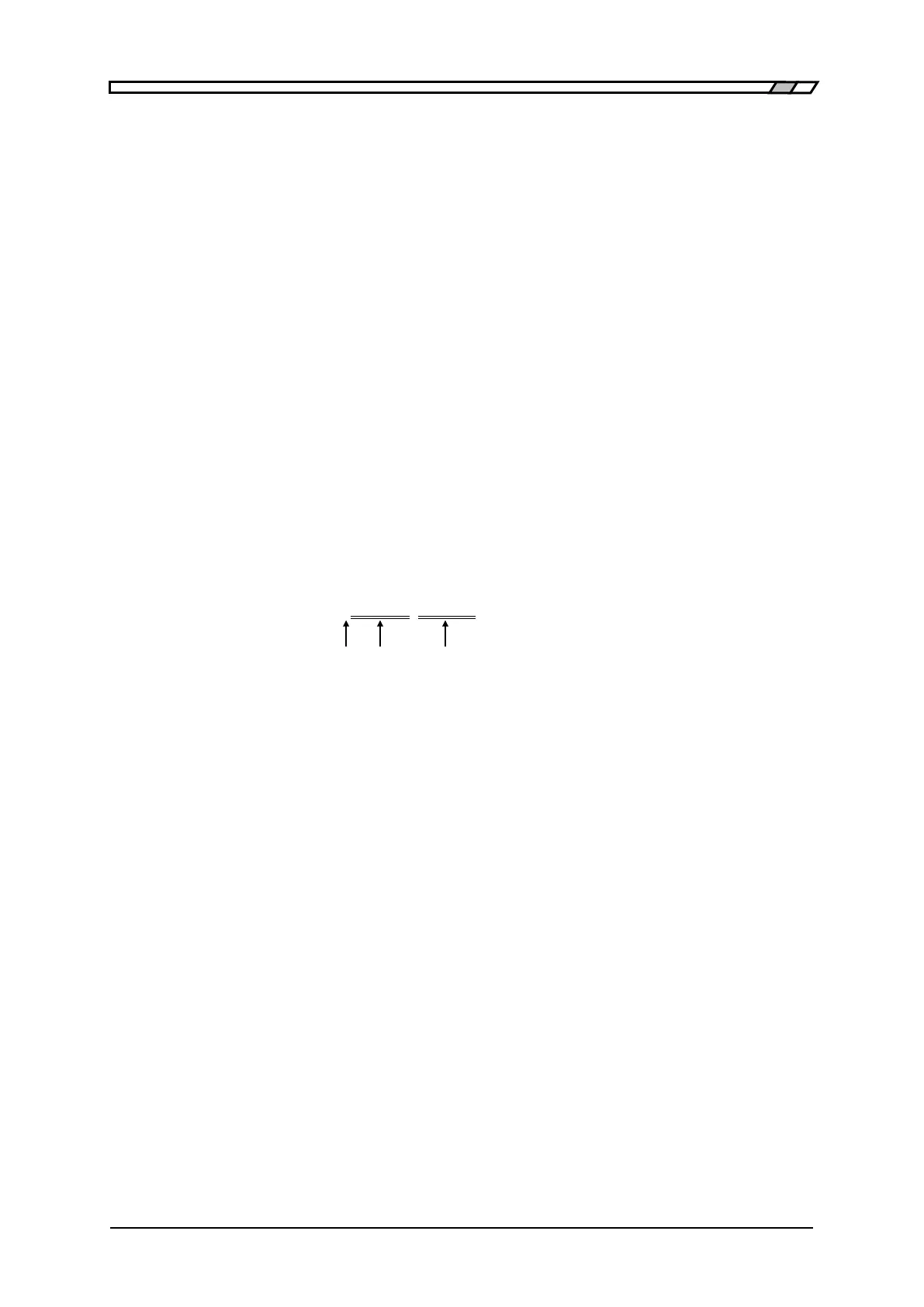
① Sets the current path as the route
② SOURce subsystem command (SOURce is a route command)
③ FREQuency command belonging to the SOURce subsystem
5.3.1.3 Command String Simplification
In the command structure, commands (including some parameters) are expressed in a combination of
uppercase and lowercase alphabet letters. Out of which the uppercase alphabet letters represent an
abbreviated form of the command. In the command syntax, commands are case-sensitive for
convenience sake, but actually they are not case-sensitive. (1) to (3) below are all acceptable but (4) and
(5) cause an error.
ex) SOURce:FREQuency?
(1) SOUR:FREQ?
(2) SOURCE:FREQUENCY?
(3) sour:freq?
(4) SOURC:FREQUE?
(5) sou:frequency?
① ② ③



 To Next Page