Synthesis Engine
Synthesis Engine
94 95
The amount of feedback determines how long it takes for the feedback to disappear
aer the input signal has faded out. This exponential process is referred to as the „Decay
Time“, which can be sensitive to Key Tracking (modeling a tendency some musical instru-
ments possess, like strings tend to dampen faster with higher notes).
The Decay parameter is bipolar, as negative feedback amounts can cancel every second
repetition, eectively tuning the signal down by one octave. The signal of the Gate enve-
lope can also be applied to the local feedback loop, reducing the amount to a certain
degree when a key is released (so the Comb Filter feedback only remains for sustained
notes).
The delay time can additionally be modulated by a crossfade mix of both branches, deter-
mined by a „Phase Modulation“ parameter (as mentioned, in certain scenarios, delay
times and phases can closely relate).
So in a general sense, the Comb Filter can act as a tunable, delay based resonator that
can strongly alter the spectrum of the incoming signal due to its integrated allpass filter.
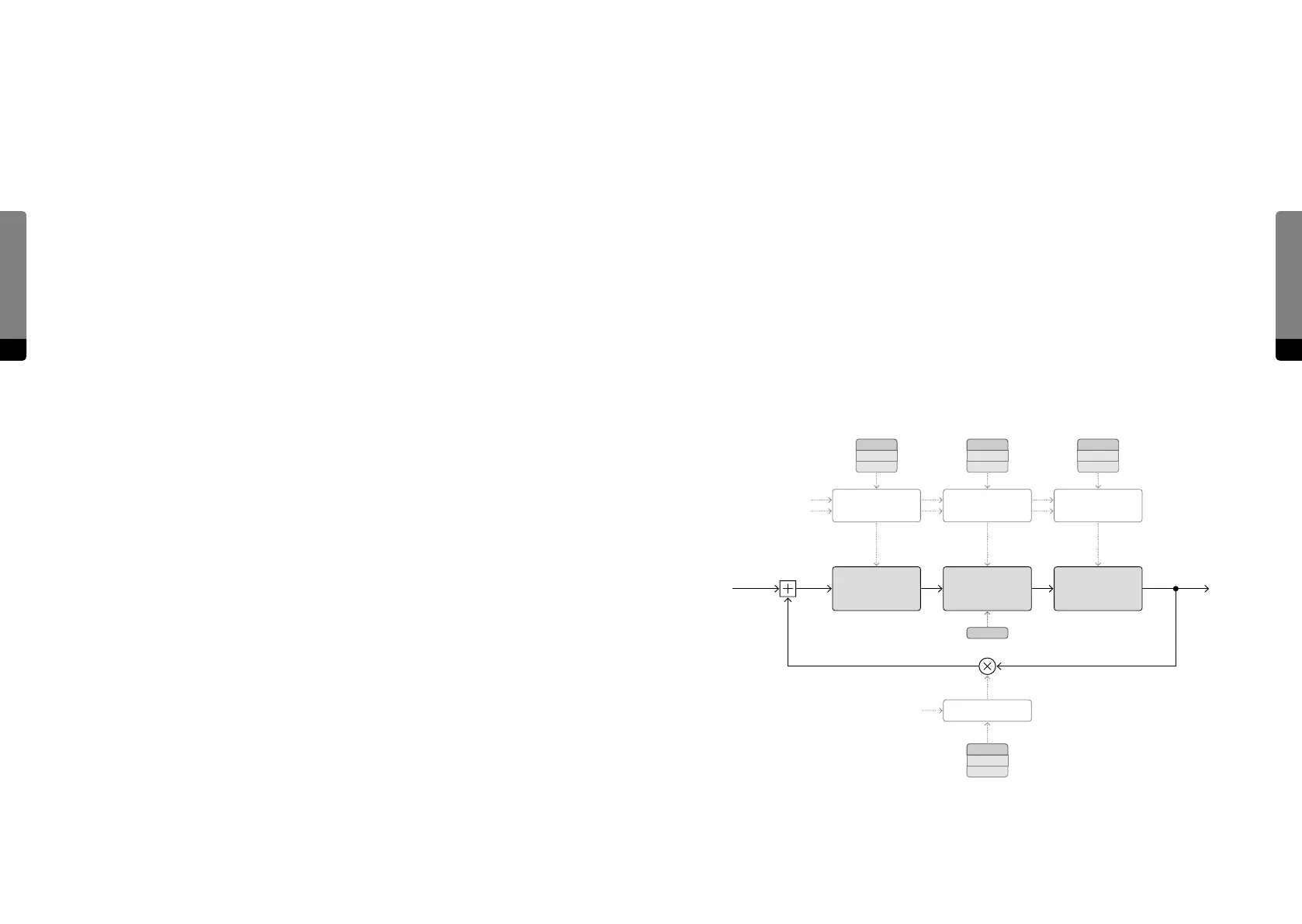
AP Reson
Decay
Pitch AP Tune Hi Cut
Note Pitch & Pitchbend
Env C
Key Trk
Env C
Key Trk
Gate
Key Trk
Env C
Key Trk
Env C
Note On/O
Delay Time
Control
Feedback Control
Center Frequency
Control
Cuto
Control
Delay 2-Pole Allpass 1-Pole Lowpass OutIn
Comb Filter
The branch signals (A, B) are provided as sources for two dierent filter units, the first of
which is the „Comb Filter“. It is an accurately tunable delay with a versatile local feedback
loop, fed by an adjustable crossfade mix of both branch signals.
The term „Comb“ describes the eect of a signal being combined with a delayed version
of itself, leading to phase interferences (which can be constructive or destructive, mainly
depending on the delay time). Certain harmonics of the input signal can be amplified or
canceled, so the spectrum is aected.
Furthermore, the term „tunable“ refers to the relationship between the delay time of
signal repetitions and a perceived tonal frequency, which emerges when the delay time is
suiciently small (smaller times produce higher frequencies, as usual). The „Pitch“ param-
eter of the Comb Filter can be sensitive to Key Tracking and the influence of Envelope C.
The delayed signal is passed to the local feedback branch, which includes two filter
components. At first, a two pole allpass filter is applied, which has a tunable frequency
which can be sensitive to Key Tracking and the influence of Envelope C and a resonance.
Allpass filters do not aect the amplitudes of certain frequency components (as high-
or lowpass filters do), but they will aect the phases of these components, which are
comparable to individual delay times. Below the (center) frequency, the phase shi is
minimal (zero), rising to 180 degrees at the frequency and then to 360 degrees above the
frequency. The Resonance parameter defines the slope of that shi. This mechanism has
a profound eect on the signal spectrum, as it can both create and destroy harmonic
signal components.
The allpass filter is followed by a lowpass filter, damping higher frequency components
according to a tunable pitch parameter which can be sensitive to Key Tracking and the
influence of Envelope C. The damping eect is closely related to acoustic processes (as
substances like air have this property). It also aects the persistence of the local feedback.


 To Next Page