53
Adjusting On Screen Displays (OSD)
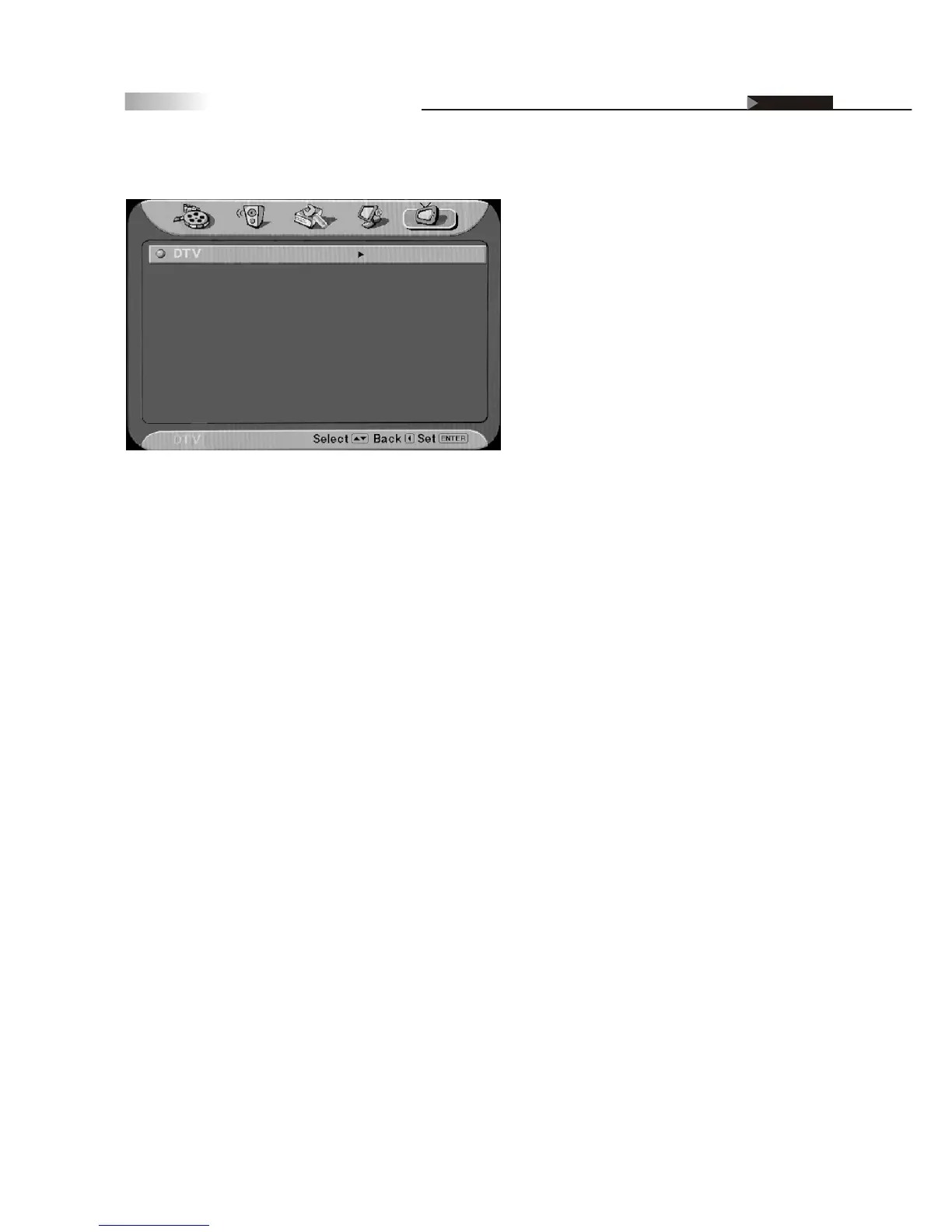
OSD-DTV
DTV:Adjusting DTV Settings
Introduction to DTV
A Brief Look at Broadcast and Digital Television
Broadcast television is a traditional way of watching TV programs
simply by installing an antenna. This is called analog TV.In recent years,
many countries have begun to mandate a transition from analog to digital
television. Digital TV provides noise-free, high-definition picture
quality, Dolby AC-3 sound effects, and a handy EPG (electronic program
guide). And the 16:9 video format gives a wider view than the traditional
4:3 format. Many TV broadcasters are now delivering digital TV
programs, so switching to a digital HDTV receiver now makes good sense.
Digital TV programs are broadcast on both VHF and UHF frequency bands.
Traditional analog TV uses one frequency channel to carry a single
station's program. With digital TV, one frequency channel can carry up to
four station programs. For example, analog channel CBS 2 may have
become 2-1, 2-2, etc. when broadcast in digital TV. Channel 2 is the major
channel and channel -1, -2, etc. are the sub-channels.
Digital TV signals are transmitted in either free-to-air (FTA) or pay-per-
view (PPV) mode. FTA programs are received free with an MPEG 2-ATSC
compliant digital receiver, such as the HDTV-ST. PPV programs can be
received only by paying an access fee to the broadcaster and by using a
digital receiver incorporating a compatible conditional access system.
In addition, the HDTV-ST lets you watch HDTV, EDTV, and SDTV
digital TV programs.
*HDTV stands for High Definition Television; the common video
formats are "1920 x 1080 interlaced" and "1280 x 720 progressive".
*EDTV stands for Enhanced Definition Television; the common video
format is "720 x 480 progressive".
*SDTV stands for Standard Definition Television; the common video
format is "720 x 480 interlaced".



 To Next Page