EasyManua.ls Logo

Onicon D-100 - User Manual

Onicon D-100
62 pages
Print Icon
To Next Page IconTo Next Page
Loading...
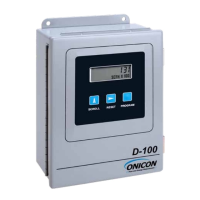
D-100 FLOW DISPLAY with NETWORK INTERFACE
Installation and Operation Guide
With
BACnet Network Interface Installation Guide
1500 North Belcher Road, Clearwater, FL 33765 • Tel (727) 447-6140 • Fax (727) 442-5699
www.onicon.com • sales@onicon.com
08-12
0634-7 / 18340

Table of Contents

Other manuals for Onicon D-100

Questions and Answers

  • S
    Sandra HenryAug 14, 2025
    Why is communication intermittent with the Lon Talk network on my Onicon D-100 Measuring Instruments?
    • A
      Antonio VillarrealAug 14, 2025
      If your Onicon Measuring Instruments device is intermittently communicating with the Lon Talk network: * Check if the network is properly terminated. The Lon TP/FT bus can be terminated in two ways: a single RC filter at any point on a free topology network or a dual termination scheme with two RC filters at the ends of bus networks. * Verify that the correct cable type is used. TP/FT networks should only use twisted shielded pair cable, such as Belden 85102 or equivalent.
  • J
    jaredphillipsAug 18, 2025
    Why won't my Onicon Measuring Instruments communicate with the network controller?
    • S
      Sarah MyersAug 18, 2025
      A possible cause is duplicate addresses, which can cause devices on the network to stop working. To resolve this, ensure that each device on the network has a unique address. Also, the RS485 network cable connections are polarity sensitive and must be connected the same way on every device. Shield drain connections should be daisy chained in the same manner as the signal cables for RS485. The maximum number of devices allowed on a RS485 network segment without a repeater is 32. RS485 cable impedance should be matched to a termination resistor at the end of the cable.
  • T
    Travis TaylorAug 21, 2025
    What to do if network communications are disrupted when connecting Onicon D-100?
    • D
      Darrell WilliamsAug 21, 2025
      The issue might be due to polarity-sensitive RS485 network cable connections; ensure they're connected consistently on every device (i.e., + to + and - to -). Another cause could be duplicate addresses; a unique address is required for each device on the network. Also, check that shield drain connections are daisy-chained in the same way as the signal cables for RS485.
  • T
    tgibsonAug 28, 2025
    Why is connecting my Onicon Monitor disrupting network communications?
    • M
      Mia HernandezAug 28, 2025
      Disruptions may occur if the RS485 network cable connections are not consistently connected with the correct polarity (+ to + and - to -) on every device. Another cause could be address conflicts; ensure each device has a unique address, as duplicate addresses can cause network issues. For TCP/IP networks, a unique IP address is required for each device; duplicate addresses will cause multiple devices to respond to the same poll, disrupting network communications. Also, make sure that shield drain connections are daisy chained and unterminated at the cable end, connected to earth only at the network master controller, and not connected to the RS485 connector.
  • U
    upattonAug 31, 2025
    What to do if there are time out errors when polling Onicon Monitor?
    • W
      William RayAug 31, 2025
      Time out errors during device polling can occur due to several reasons. Polling for invalid registers will slow the response time. Valid integer registers range from 40001 to 40068, and floating point registers range from 41003 to 41081. Resetting totals, which requires writing to a register, takes longer than reading and can also cause time out issues. Temporarily extend the allowable delay to see if the problem goes away.
  • J
    jordan36Sep 3, 2025
    What to do if Onicon Monitor has time out errors when polling the device (MODBUS RS485 or MODBUS TCP/IP)?
    • S
      Shelly EdwardsSep 4, 2025
      If time out errors occur when polling the Onicon Monitor (MODBUS RS485 or MODBUS TCP/IP), consider the following: 1. Check which registers are being polled. Polling for invalid registers can slow the response time. Valid integer registers range from 40001-40068, and valid floating-point registers range from 41003-41081. 2. Resetting totals requires the network controller to write a 1 to a register in our device, which takes longer than reading registers and can lead to time out issues. Temporarily extend the allowable delay to see if the problem goes away.
  • B
    Brenda BergSep 7, 2025
    What to do if the displayed flow rate is too high or too low on Onicon D-100?
    • M
      Matthew WiseSep 7, 2025
      If the displayed flow rate on your Onicon Measuring Instruments is too high or too low, start by verifying the pipe size. If it differs from the calibration tag, contact Onicon. For insertion meters, ensure correct insertion using a depth gauge and that the flow meter electronics enclosure is parallel with the pipe. For dual turbine meters, confirm that both turbines are producing pulses. Also, check the turbines for any debris and verify the supply voltages to both the display and the flow meter.
  • K
    Katherine WalkerSep 10, 2025
    How to troubleshoot no flow signal on Onicon turbine meters?
    • V
      Victor SmithSep 10, 2025
      If you're not getting a flow signal from your Onicon turbine meter while the hydronic system is active, check the following: * Verify the 24 VDC supply voltage to the flow meter. * For insertion meters, ensure the flow meter is correctly inserted into the pipe, using a depth gauge, and that the flow meter electronics enclosure is parallel with the pipe. * Verify correct wiring to the flow meter, referring to the wiring diagram. * Check the turbines for clogging due to debris. * Confirm that flow is actually present in the line. Note: Flow meter function cannot be verified by blowing on the turbines, as the sensing system requires a conductive liquid to operate. Test it by swirling it in water and looking for the flow indicator LED to flash at the D-100.
  • T
    Tracy UnderwoodNov 23, 2025
    How to fix Onicon Monitor not communicating with network controller?
    • K
      Katie RobersonNov 24, 2025
      First, check if the receive LED is flashing on the network board, which indicates network traffic. If not, inspect for an open network cable. Also, verify if the transmit LED is flashing when the device responds to a poll. Ensure each device has a unique address to avoid conflicts. Confirm that the RS485 network cable connections are correctly connected with the correct polarity (+ to + and - to -) on each device. The Baud rate setting must match the network Baud rate. Make sure that shield drain connections are daisy chained and unterminated at the cable end, connected to earth only at the network master controller, and not connected to the RS485 connector. For RS485 networks, ensure you haven't exceeded the maximum of 32 devices without a repeater and that the RS485 cable impedance is ma...

Summary

APPENDIX

A-1 D-100 Display Mother Board

Diagram of the D-100 display mother board, showing component layout and terminal connections.

A-2 D-100 Processor Board

Diagram of the D-100 processor board, highlighting key switches and connectors.

A-3 D-100 Power Supply Board

Diagram of the D-100 power supply board, showing fuse holders and VAC connection points.

A-4 D-100 Analog Output Board

Diagram of the D-100 analog output board, showing component layout for analog signal output.

A-5 D-100 Analog Output Board With 4 Analog Outputs

Diagram of the D-100 analog output board with four analog outputs, showing component layout.

A-6 Conditions of Sale

Outlines ONICON's terms, conditions of sale, warranty, and liability.

1.0 INTRODUCTION

1.1 Purpose of This Guide

Explains the guide's objective: installation, commissioning, operation, and servicing of the D-100.

1.2 Typical D-100 Network Interface Module

Describes the D-100 as a totalizing display for flow rate and total data, with network communication.

1.3 Standard Features and Specifications

Lists main features like enclosure type, inputs, power supply, outputs, and directional indication.

1.4 Additional Required Hardware

Details other hardware needed, specifically flow meters and ONICON's advice on selection.

1.5 Working Environment

Specifies suitable industrial environments and temperature ranges for the D-100.

1.6 Warranty & Serial Number

Covers ONICON's warranty policy and the location of serial numbers for identification.

2.0 UNPACKING

2.1 Checking That You Have Received Everything

Guide to inspecting received items against documentation and reporting missing parts.

3.0 INSTALLATION

3.1 Site Selection

Advises on choosing appropriate locations for components to ensure easy installation and maintenance.

3.2 Mechanical Installation

Provides guidance on mounting the display unit in an accessible, vibration-free location.

3.3 Electrical Installation

Details wiring and connection procedures for power, inputs, and outputs.

3.3.1 Input Signal Connections from Flow Meter

Details wiring for various ONICON flow meter models to the D-100 input terminals.

3.3.2 Average Frequency (Pulse) Flow Input

Explains input for frequency or scaled pulse signals and configuration options.

3.3.3 Analog Input (Flow)

Describes input for 4-20mA signals and configuration assistance.

3.3.4 Directional Contacts

Details input for flow direction determination using contact closures.

3.3.5 Auxiliary Rate Inputs

Covers optional analog rate inputs for powering sensors and receiving data.

3.3.6 Auxiliary Pulse Input

Explains optional auxiliary pulse input for external devices like gas meters.

3.3.7 Totalizer Outputs and Mode Status

Details output relays for flow total and mode status indications for different flow meter types.

3.3.8 Isolated Analog Outputs

Describes configurable analog outputs for replicating input signals.

3.3.9 Input Power

Details input voltage options and proper connection procedures for safe operation.

4.0 D-100 START-UP AND COMMISSIONING

4.1 Display and Keypad

Explains the display layout, lines, and function of the three membrane keys.

4.2 Processor Start-Up

Describes the display's behavior upon power application and navigating run mode pages.

4.3 Units and Multipliers

Notes that operating mode, units, and multipliers are factory-programmed and can be re-programmed.

4.4 Analog Outputs

Explains that changing units/multipliers affects analog outputs and advises seeking assistance.

4.5 Enabling; Disabling Front Panel Reset

Provides a step-by-step procedure to enable or disable the front panel reset functionality.

4.6 Commissioning

Outlines the process to verify correct installation and operation of the D-100 and flow meter.

5.0 DIAGNOSTICS

5.1 Diagnostics

Explains the D-100's diagnostic capabilities, including indicator lights and self-test signals.

5.2 Troubleshooting Guide for D-100 Display

Provides solutions for common reported problems like zero flow or incorrect readings.

SECTION 1: INTRODUCTION

1.1 Purpose of This Guide

Explains the guide's objective: installation, commissioning, operation, and servicing of the D-100 BACnet serial interface.

1.2 Typical D-100 Flow Display

Describes the D-100 as a totalizing display with optional BACnet interface for building control networks.

1.3 Specifications

Details specifications for BACnet MS/TP and UDP/IP network interfaces, including addresses and baud rates.

1.4 Network Signal Connections

Details wiring and connection procedures for BACnet MS/TP and BACnet/IP.

1.5 BACnet MS;TP Baud Rate, Biasing & Termination

Explains configuration for Baud rate, biasing, and termination resistor for MS/TP.

1.6 Network Addressing

Details procedures for assigning MAC, device instance, IP, and gateway addresses.

SECTION 2.0: BACnet PICS AND OBJECTS

2.1 PIC Statements

Provides the Protocol Implementation Conformance Statement (PICS) for the BACnet interface.

2.2 BAC Objects

Lists and describes BACnet objects supported by the D-100, including their units and notes.

SECTION 3.0: NETWORK TROUBLESHOOTING TIPS

3.1 Troubleshooting

Offers solutions for common network communication issues like device not communicating or disrupted connections.

Onicon D-100 Specifications

General IconGeneral
BrandOnicon
ModelD-100
CategoryMeasuring Instruments
LanguageEnglish

Related product manuals