Operation
21
DTX-2200-3000 AC/DC
14.2 Electrode welding (MMA)
The welding electrode is used to weld most metals (various types steel, etc.),for which rutilic and basic
electrodes are used.
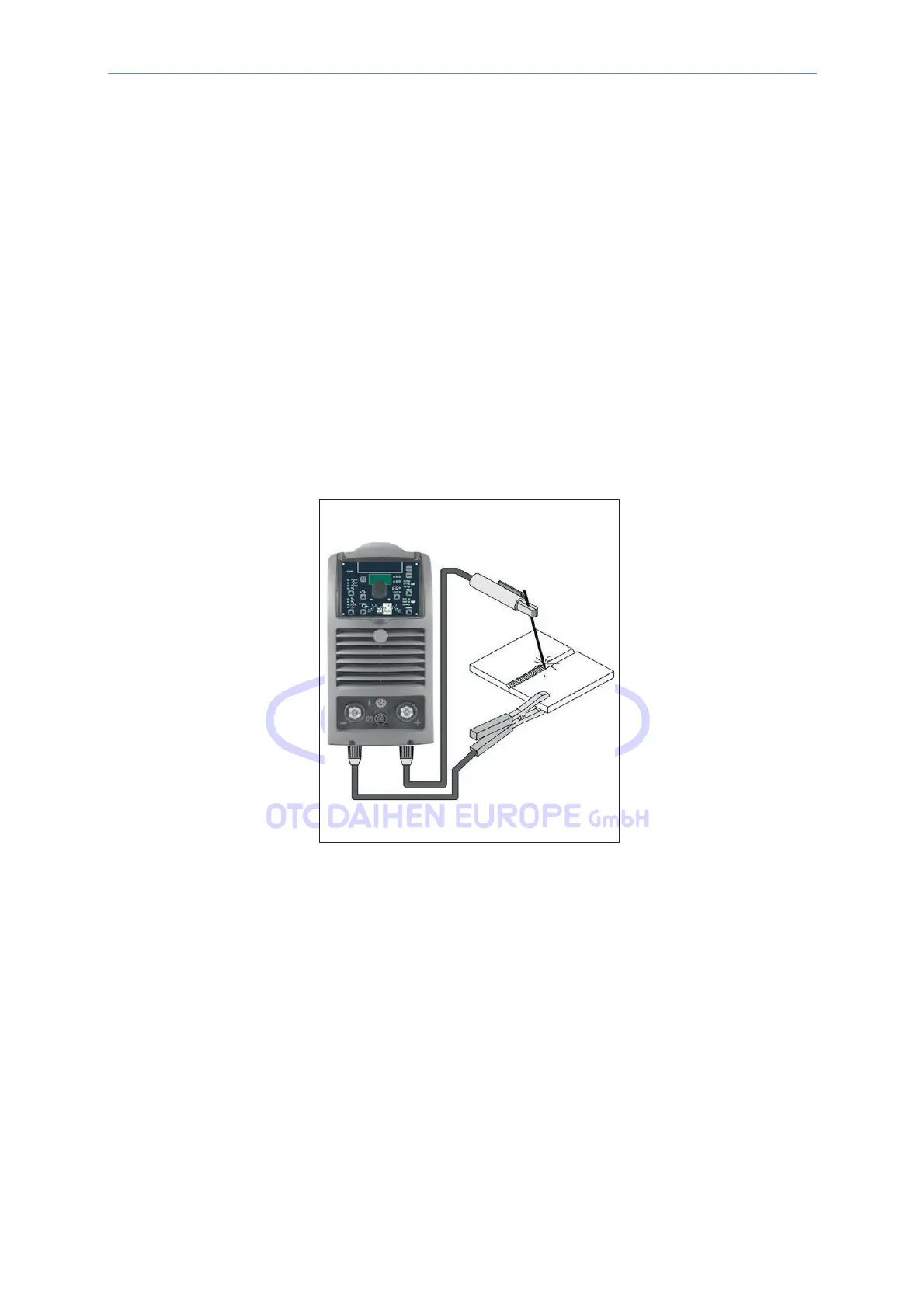
1) Connecting the welding cables (Image 6):
Disconnect the machine from the main power supply and connect the welding cables to the output terminals
(Positive and Negative) of the welding machine, attaching them to the clamp and ground with the polarity
specified for the type of electrode being used (Image 6). Always follow the electrode manufacturer’s
instructions. The welding cables must be as short as possible; they must be near to one another, positioned
at or near floor level. Do not touch the electrode clamp and the ground clamp simultaneously.
2) Switch the welding machine on by moving the power supply switch to I (Pos. 6, Image 1).
3) Make the adjustments and select the parameters on the control panel (for further information chapter 14.3).
4) Carry out welding by moving the torch to the work piece. Strike the arc (press the electrode quickly against
the metal and then lift it) to melt the electrode, the coating of which forms a protective residue. Then continue
welding by moving the electrode from left to right, inclining it by about 60° compared with the metal in relation
to the direction of welding.
Image 6
14.2.1 Part to be welded
The part to be welded must always be connected to ground in order to reduce electromagnetic emission. Much
attention must be afforded so that the ground connection of the part to be welded does not increase the risk of
accident to the user or the risk of damage to other electric equipment. When it is necessary to connect the part to
be welded to ground, you should make a direct connection between the part and the ground shaft. In those
countries in which such a connection is not allowed, connect the part to be welded to ground using suitable
capacitors, in compliance with the national regulations.



 To Next Page