Chapter 2. Installation
2.1 Introduction
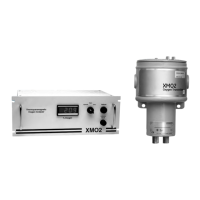
This chapter describes how to install the XMO2 transmitter
and its sample system. It also contains information on
connecting optional system components. Installation of the
XMO2 system consists of three basic steps:
1. Installing the XMO2 transmitter in the sample system (if
you purchased your sample system from Panametrics,
this step has already been done for you)
2. Mounting, plumbing, and wiring the sample system
3. Making wiring connections for power input, 4-20 mA
analog output, RS232 digital output, and optional
external devices
2.2 Installing the XMO2 transmitter
Note: This section applies only if the XMO2 transmitter
has not already been installed in the sample system by
Panametrics.
The sample system must deliver a clean, representative gas
sample to the XMO2 at the proper temperature, pressure
and flow rate. This usually means a clean, dry gas sample
that is free of solid and liquid particulates and is delivered at
atmospheric pressure, a temperature no greater than 40°C
(104°F), and a flow rate of approximately 1.0 SCFH (500 cc/
min). A typical sample system for the XMO2 might include
an inlet gas flow regulating needle valve, a sample gas flow
meter, and a pressure gauge.
Note: Because factory calibration of the XMO2 is done
at atmospheric pressure and at a flow rate of 1.0 SCFH,
operation of the XMO2 at other pressures and/or flow rates
requires a field recalibration to ensure optimum accuracy.
To install the XMO2 transmitter in the sample system,
complete the following steps:
1. Select a location in the sample system that provides at
least 9 in. (230 mm) of clearance above the top cover
of the XMO2 for access to the interior of the transmitter
enclosure.
2. Mount the XMO2 transmitter in the sample system via
its two mounting holes. Be sure that the transmitter is
upright and is level to within ±15°.
3. Use 1/4” stainless steel tubing to connect the sample
system Inlet and Outlet fittings to the corresponding
XMO2 ports.
WARNING!
For explosion-proof units, be sure to
conform to all safety and electrical code
requirements.
2.3 Installing the sample system
You can order a complete sample system from Panametrics
that is mounted on a steel panel and includes the XMO2
transmitter and all necessary components and plumbing.
Several standard sample systems are available, and
custom-designed sample systems can be built to your
exact specifications.
2.3.1 A Basic system
Figure 5 shows a basic sample system (dwg #732-164) that
has been designed for use with the XMO2 transmitter.
The sample system shown in Figure 5 on page 7 consists of
a painted steel plate with the following components
mounted on it:.
• Inlet needle valves for sample, zero, and span gas flow
regulation
• Ball valves for flow selection
• An XMO2 transmitter
• A sample gas outlet pressure gauge
• A sample gas flowmeter
Other components, such as a pump, a filter/coalescer, or a
pressure regulator could be added to the system if needed.
2.3.0a Mounting the sample system
To mount the sample system, complete the following steps:
1. Select a location that is as close as possible to the
process sampling point. The ambient temperature at
this location should be in the range of -20° to +40°C (-4°
to +104°F).
IMPORTANT:
A For locations where the ambient temperature falls
below -20°C (-4°F), install the sample system in a heated
enclosure
2. Using the mounting holes provided, fasten the sample
system to a convenient vertical surface. The system
must be installed in an orientation that keeps the XMO2
transmitter upright and level to within ±15°.
3. After the sample system has been mounted, use 1/4”
stainless steel tubing to connect all inlet and outlet
lines to the 1/4” tube fittings on the sample system. The
sample line leading from the process to the sample
system should be as short as possible in order to
decrease system lag time and to prevent condensation
in the line.
6


 To Next Page