A typica The sample system in Figure 59 on page 40
consists of:
• An eductor to draw the sample from and return it to the
vapor space above the liquid in the storage tank
• A liquid separator/dump to remove condensable liquids
• A filter/coalescer for the removal of solid and liquid
particulates
• Automatic calibration gas solenoid valves for the
automatic calibration of the system on a timed basis
• Flowmeters
• Pressure gauges
All components are mounted on a painted steel plate that is
usually housed in a heated enclosure.
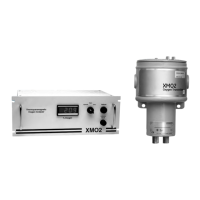
Note: An optional TMO2D display/controller (or similar
device) is required for automatic calibration of the XMO2.
A.1.3 Basic operating procedure
The sample system should be located at or near the top of
the storage tank so that condensate can drip back into the
tank. The gas used to purge the tank provides the motive
force in the eductor to pull a gas sample from the vapor
space above the hydrocarbon liquid into the sample system.
The sample gas, condensed liquids, and the inert gas are
all returned to the tank, making this is a closed-loop system.
The XMO2 is recalibrated periodically using the purge gas
to zero the instrument and ambient air (20.93% O
2
) to span
the instrument. The span gas can optionally be vented to
atmosphere, so that air is not introduced into the storage
tank.
For this application the required calibration gases are:
• Zero Gas: N
2
or CO
2
(at least 99.95% pure)
• Span Gas: air (20.93% O
2
)
A.1.4 Previous systems
Electrolytic cells were once commonly used for this
application. However, such systems required extensive
maintenance and frequent manual calibration. In addition,
the cells were easily damaged by condensable liquids,
requiring frequent cell replacement. As the XMO2 provides
continuous monitoring of the O
2
content with maintenance-
free operation, it is now the system of choice.
41


 To Next Page