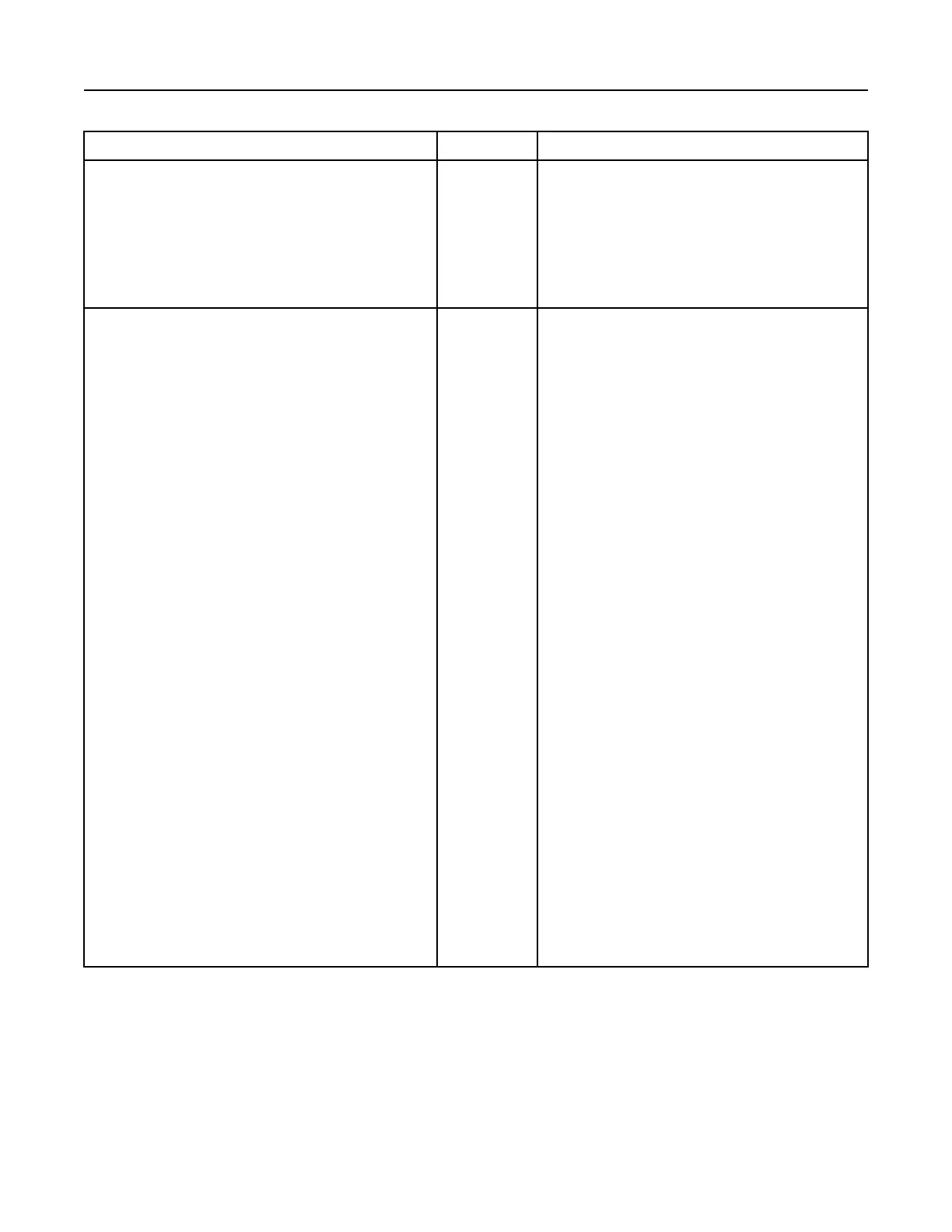
Table 66
Troubleshooting Test Steps
Values Results
1. Diagnostic Codes
A. Use the electronic service tool to check for active or logged
codes.
Diagnostic codes Result: A diagnostic code is present.
Repair: Troubleshoot the code and then reset the
histogram.
Result: A diagnostic code is not present.
Proceed to Test Step 2.
2. Visible Faults
A. Check that the fuel supply valve (if equipped) is in the OPEN
position.
B. Check for the correct level of fuel, oil, and coolant.
C. Check for water in the primary fuel filter/water separator.
D. If the ambient temperature is below 0 °C (32 °F), check the
specification of engine oil and oil for the machine.
E. Visually inspect the engine for the following faults:
· Missing components
· Damaged components
· Damaged electrical cables or loose electrical cables
· Oil leaks
· Fuel leaks
· All fuel filters are correctly installed.
F. Check that the battery voltage is correct.
G. Use the electronic service tool to check the average cranking
speed of the engine.
Visible faults Result: The fuel supply valve (if equipped) is not in the
OPEN position.
Repair: Move the fuel supply valve to the OPEN position.
Result: The level of fuel, oil, or coolant is not correct.
Repair: Replenish any fluids with an incorrect level.
Result: Water is present in the primary fuel filter/water
separator.
Repair: Drain any water from the primary fuel filter/water
separator.
Result: The correct specification of engine oil and oil for
the machine is not in use.
Repair: Replenish the system with oil of the correct specifi-
cation for the ambient conditions.
Result: Battery voltage is low.
Repair: Check the batteries. Refer to Troubleshooting,
“Battery Problem”.
Result: The cranking speed is less than 150 rpm.
Repair: Investigate the cause of the low cranking speed
and rectify, as necessary.
Note: The following step is only applicable to engines that
have a Diesel Particulate Filter (DPF).
If the DPF frequently collects excessive soot prior to this
fault, there may be a faulty cylinder in the engine. Proceed
to Test Step 12.
Result: All checks are OK.
Proceed to Test Step 3.
(continued)
UENR4469-36 133
Symptom Troubleshooting
Copyright of Perkins Engine Company Limited. NOT FOR REPRINTING OR RESALE





 To Next Page