CAN Controllers and Acceptance Filter 205 May 03, 2004
Philips Semiconductors Preliminary User Manual
LPC2119/2129/2292/2294ARM-based Microcontroller
Central Miscellaneous Status Register (CANMSR - 0xE004 0008)
GLOBAL ACCEPTANCE FILTER
This block provides lookup for received Identifiers (called Acceptance Filtering in CAN terminology) for all the CAN Controllers.
It includes a 512 x 32 (2K byte) RAM in which software maintains one to five tables of Identifiers. This RAM can contain up to
1024 Standard Identifiers or 512 Extended Identifiers, or a mixture of both types.
If Standard (11-bit) Identifiers are used in the application, at least one of 3 tables in Acceptance Filter RAM must not be empty.
If the optional “fullCAN mode” is enabled, the first table contains Standard identifiers for which reception is to be handled in this
mode. The next table contains individual Standard Identifiers and the third contains ranges of Standard Identifiers, for which
messages are to be received via the CAN Controllers. The tables of fullCAN and individual Standard Identifiers must be
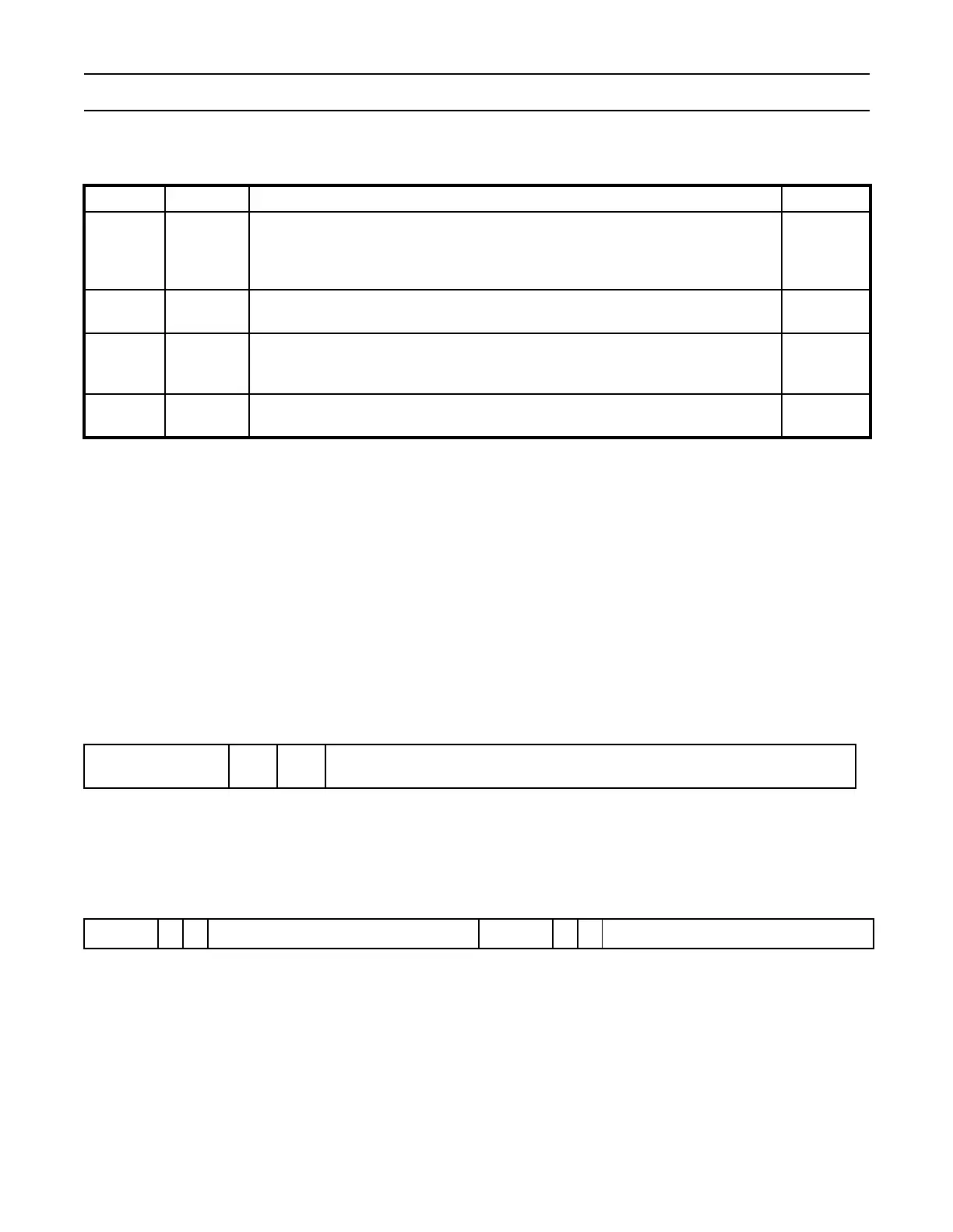
arranged in ascending numerical order, one per halfword, two per word. Since each CAN bus has its own address map, each
entry also contains the number of the CAN Controller (001-110) to which it applies.
The table of Standard Identifier Ranges contains paired upper and lower (inclusive) bounds, one pair per word. These must also
be arranged in ascending numerical order.
The disable bits in Standard entries provide a means to turn response, to particular CAN Identifiers or ranges of Identifiers, on
and off dynamically. When the Acceptance Filter function is enabled, only the disable bits in Acceptance Filter RAM can be
changed by software. Response to a range of Standard addresses can be enabled by writing 32 zero bits to its word in RAM,
and turned off by writing 32 one bits (0xFFFF FFFF) to its word in RAM. Only the disable bits are actually changed. Disabled
entries must maintain the ascending sequence of Identifiers.
Table 145: CAN Central Miscellaneous Status Register (CANMSR - 0xE004 0008)
CANMSR Name Function Reset Value
3:0 ES4:1
1: one or both of the Tx and Rx Error Counters has reached the limit set in the EWL
register (same as ES in CANGSR)
ES4:3 are available in LPC2294 only. In other parts these bits are reserved.
0
7:4 Reserved
Reserved. User software should not write ones to reserved bits. The value read from
a reserved bit is not defined.
NA
11:8 BS4:1
1: the CAN controller is currently involved in bus activities (same as BS in CANGSR)
BS4:3 are available in LPC2294 only. In other parts these bits are reserved.
0
31:12 Reserved
Reserved. User software should not write ones to reserved bits. The value read from
a reserved bit is not defined.
NA
31
15
29
13
26
10
16
0
Controller #
Dis
able
not
used
Identifier
Figure 35: Entry in fullCAN and Individual Standard Identifier Tables
31 29 26 16 10 0
Controller #
dis
able
not
used
Lower Identifier Bound
Controller #
dis
able
not
used
Upper Identifier Bound
Figure 36: Entry in Standard Identifier Range Table



 To Next Page