Safety
Operating Manual PSENmlock mini, PSEN mlm 1 sa 1.1/2.1/2.2
1005802-EN-02-Draft
| 7
2 Safety
INFORMATION
If the auxiliary release screw is not turned back correctly after use, guard
locking cannot be activated/deactivated.
2.1 Intended use
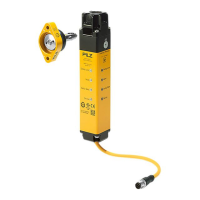
PSENmlock mini is used for safe guard locking and safe interlocking on small swing gates
and sliding gates, as well as flaps and covers. It prevents a safeguard from being opened
while a hazardous machine function is being performed.
The hazardous machine function may only be executed under the following conditions:
} There is a high signal at safety outputs 12 and 22 and
} There is a low signal at safety inputs S31 (Lock/Unlock Request 1) and S41 (Lock/Unlock
Request 2).
Safety inputs S31 and S41 (solenoid operation) may only be operated under the following
condition:
} Plant is in a safe condition
Make sure that this is the case with an AND operation in the safety system immediately
before the output is operated.
The safety switch meets the requirements in accordance with:
} EN 60947-5-3: PDDB
} EN ISO 13849-1: PL d (Cat. 3)
} ENISO14119
– Interlocking device with guard locking
– Coding level with actuator PSEN mlm 1 sa 1.1: low, type 4
– Coding level with actuator PSEN mlm 1 sa 2.1/2.2: high, type 4
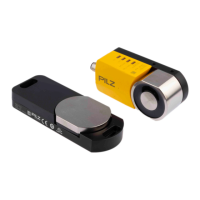
The safety switch may only be used with one of the approved actuators (see Approved
combinations [
12]). Only mounting aids provided by Pilz may be used to make the at-
tachment.
Safety level PL d (Cat. 3) is only achieved when
} For the interlock, the safety outputs have 2-channel processing
} For guard locking, the solenoid has 2-channel operation via safe, tested outputs, suitable
for PL d (Cat. 3) applications.
With 1-channel operation of the safety inputs S31 (Lock/Unlock Request 1) and S41 (Lock/
Unlock Request 2), it is only possible to achieve safety level PLd(Cat.2).
The following is deemed improper use in particular
} Any component, technical or electrical modification to the product,
} Use of the product outside the areas described in this operating manual,
– Use under corrosive environmental conditions (cooling emulsions, surface treatment,
gases, ...),


 To Next Page