21
Laboratory Oscillator 2
Overview
Laboratory Oscillator 2 utilizes a refined version of our temperature stabilized,
analog VCA saw wave oscillator core. The internal signal path passes the core
saw waveform through up to 5 wave shapers before reaching the output.
Pulse Symmetry
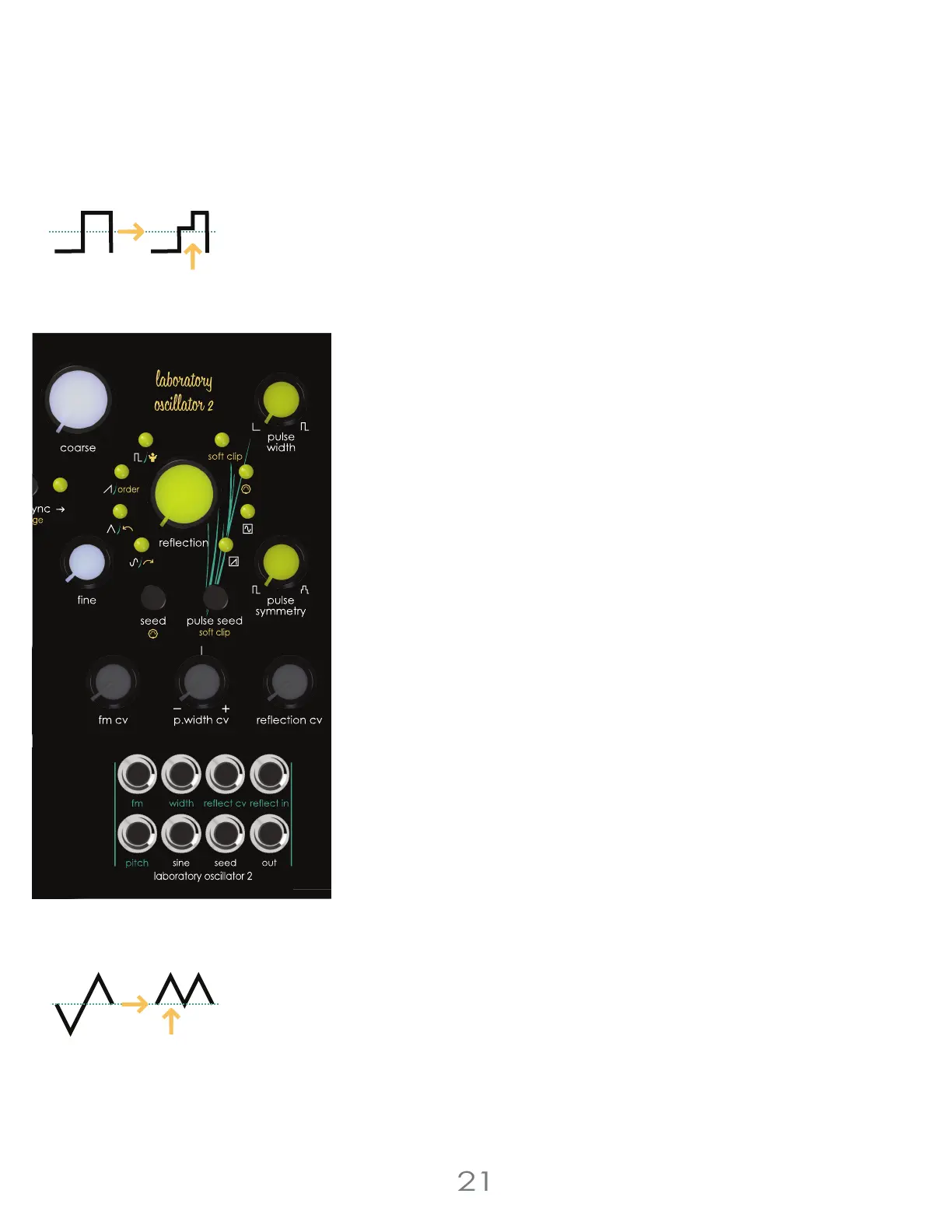
Laboratory Oscillator 2 introduces Pulse Symmetry to synthesis. Pulse Symmetry
creates a new type of pulse wave with the addition of an adjustable step.
Using an oscilloscope, the waveform looks like a set of stairs where both the
pulse width and the height of the step can be adjusted.
The Pulse Seed determines the internal wave used to create the pulse wave,
sine, saw, or both. Each wave results in a different pulse wave shape.
The [PULSE WIDTH KNOB] sets the pulse width. Pulse width can be modulated
using the [P.WIDTH CV ATTENUVERTER] and [WIDTH JACK]. The [PULSE SYMMETRY
KNOB] sets the height of the step.
The [PULSE SEED BUTTON] determines what waveform is used to create the
pulse wave; sine, saw, or both. This impacts how pulse symmetry looks and
sounds.
Reflection
The [REFLECTION KNOB] flips the bottom half of the waveform back onto the
top half. The results are different for every waveform. Looking at an
oscilloscope, a sine doubles in frequency, a saw morphs into a triangle, and a
pulse symmetry wave gains additional complexity.
Reflection can be modulated using the [REFLECT CV JACK]. The [REFLECT IN
JACK] is the audio input to waveform reflection. Patching into this overrides the
signal path to waveform reflection with an external audio signal. This means
the first oscillator or any other audio signal can be patched through wave
reflection.
Soft Clipping
Use [EDIT BUTTON] + [PULSE SEED BUTTON] to enable or disable soft clipping. Soft
clipping smooths out the resulting waveform for a mellower sound.
3 Voltage Lab 2 Voice Modules
Pulse
Symmetry
Reflection


 To Next Page