Poseidon SE7EN+ User Manual Chapter 1 Page 8
in the CO
2
absorbent cartridge lid. Axial o-rings are laid into an annular groove in the body of
the object to be sealed.
The object is then pressed perpendicularly agains a at, clean sealing surface. The axial o-ring
is then compressed along its top side by the at mating surface and compressed into the
groove. This compression of the o-ring causes it to seal against the sides of the groove and to
the at mating surface. Because a release of the mating pressure would result in a leak in a
face type seal, these require a securing mechanism that not only prevents the part from lifting
off accidentally, but also actively compresses the axial o-ring against the at mating surface. In
the case of the CO
2
cartridge, the cartridge end plate is equipped with four thumb screws to
secure it in place and tighten it down.
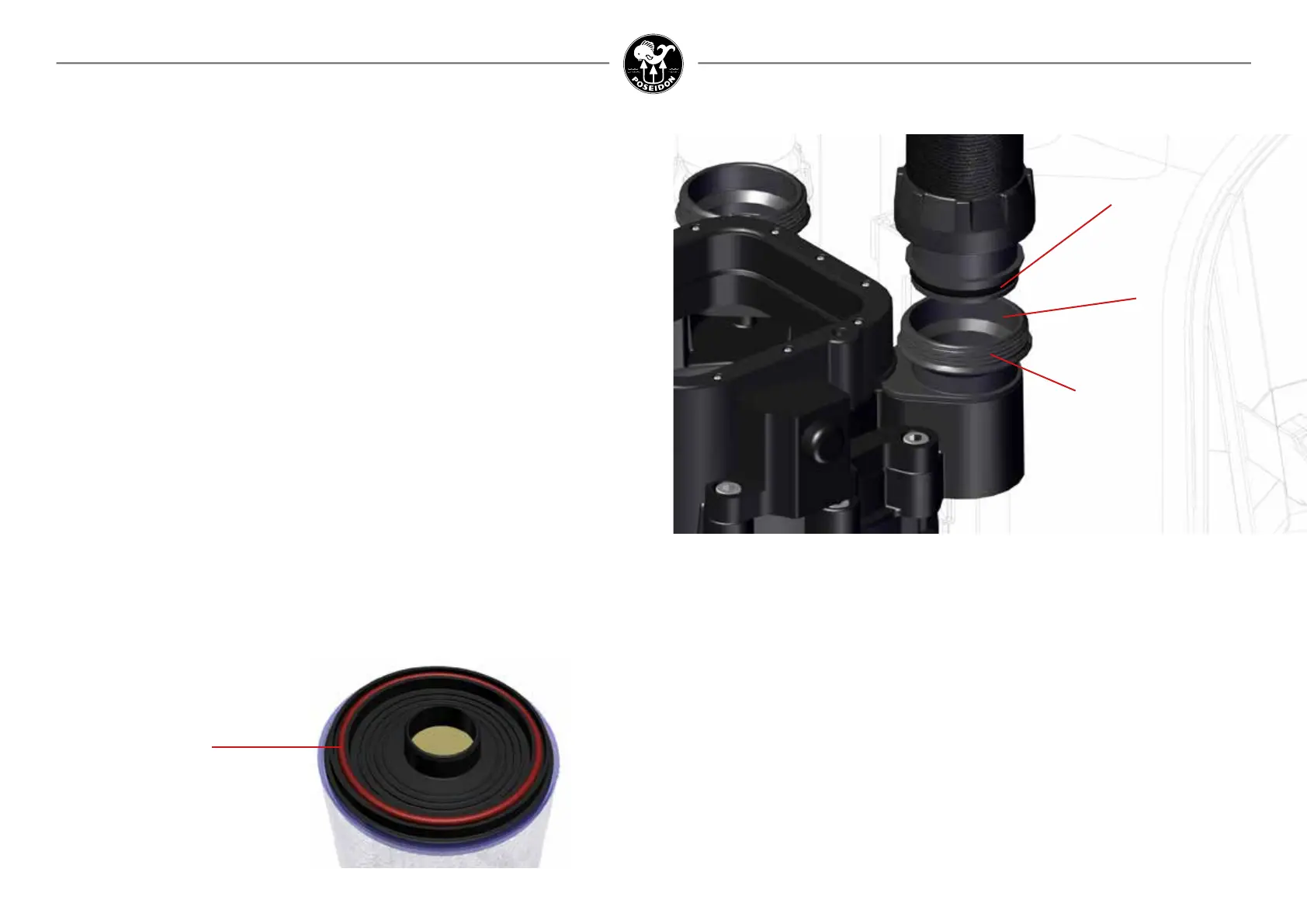
A second, and more commonly used seal is the “ radial “ o-ring. Figure 1-12 shows a typical
implementation in the Poseidon SE7EN+ breathing hose and hose connection ports. In
contrast to a axial o-ring seal, a radial seal involves a circular groove that goes around a cylin-
drical or semi-cylindrical object (it can be a rectangular object with rounded corners provided
the corners have a sufciently large radius – an example of this is the Electronics Module dual
radial seals). In a radial seal, the groove is designed such that the o-ring snaps into the groove
with a certain pre-tension. Once seated the o-ring cannot leave the groove. To complete the
seal, the side of the connection containing the radial o-ring and groove is inserted into a cylin-
drical receiving surface. As the o-ring is inserted, the cylindrical surface uniformly compresses
the radial o-ring and creates the seal against all contacting surfaces. The important distinction
is that with a radial seal it is possible to rotate the objects relative to one another and still retain
a good waterproof seal. This is the reason the breathing hoses use radial seals, for example
– so that you can adjust their positions and that of the mouthpiece without having to make and
break the connections.
Radial o-ring seals still require a retainer to prevent them from accidental disassembly during
diving. For hose connections we use rotating shells whose threads engage a capture thread
on the mating part (see Figure 1-11 for example).
For face and radial o-rings to properly work, the diver is responsible for ensuring the
following:
• The o-ring is clean and free of debris and scratches (no cuts, gouges, dust, dirt, sand, hair, etc.)
• The o-ring is lubricated with an approved o-ring grease.
• The sealing surfaces are clean and free of debris, scratches and gouges.
• The sealing surfaces are lubricated with an approved o-ring grease.
• The retainer mechanism (e.g. hand screws, hand nuts, or threaded shells) is securely
in place.
”Radial” o-ring seal
Sealing surface for
”radial” o-ring seal
Retainer nut capture thread
Figure 1-11.
Typical “ Face “ type o-ring seal.
Figure 1-12. Typical “ Radial “ type o-ring seal.
“ Face “ o-ring seal
The Poseidon SE7EN+ is a computer-controlled precision underwater instrument. Its success-
ful continued operation depends upon preventing water from entering the breathing loop, gas
processor, and electronics systems. To do this, and to keep the rig modular and easy to use
and maintain, there are dozens of o-ring seals. These fall into two design classes: “axial” o-ring
seals and “radial” o-ring seals. Figure 1-10 shows a typical use of a axial o-ring seal, as used
O-ring care and maintenance


 To Next Page