Poseidon SE7EN+ User Manual Chapter 2 Page 41
If the system is powered-up by inserting the battery, the system continues directly to the “all-
segments” screen (Figure 2-4), without the need to complete the power-up conrmation routine.
The Poseidon SE7EN+ electronics system conducts 55 automated and semi-automated tests
during the pre-dive routine. This procedure veries a wide variety of parameters, and takes
about 3 minutes to complete. A full description of all of the tests is included in Appendix 1 of
this Manual, but a general description – including tests that require intervention – is included here.
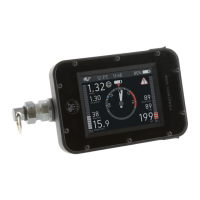
Figure 2-4. The Primary Display showing
all LCD elements.
DANGER:
Do not attempt to breathe on the Poseidon SE7EN+ during the
automated pre-dive routine. Oxygen control is disabled during
portions of this routine, so doing so involves a risk of hypoxia. Do
not attempt to conduct a dive until the system has successfully
completed the pre-dive routine.
Power-up self test (test 1 - 38)
The rst series of tests (numbers 1–38) are referred to as Power-Up Self-Tests (or PSTs). They
are internal checks on the functionality of all of the various sensors, computers, actuators, and
alarm systems in the Poseidon SE7EN+. You will see and hear the rig as it tests the HUD light
Test numbers 1–16 are conducted with the backlight off, allowing more precise measurement
of the power consumption of individual components, such as the various alarms and solenoid
valves. Test 17 checks the power consumption of the backlight (Figure 2-5); and the backlight
remains on for the remainder of the pre-dive tests. The test number is displayed on the left side
of the screen, preceeded by a lower-case “t” (as shown in Figure 2-5). While the test is running,
a “spinning wheel” is displayed on the right side of the display, where the remaining dive time
is normally displayed. This “spinning wheel” is represented by a “0” character in the right-most
position, missing one of the segments. The missing segment rotates positions around the “0”
in a clockwise direction. Different tests require different amounts of time to complete; some
require less than one second, others require 4–12 seconds to complete. Certain tests that
involve some action by the diver allow for up to 2 minutes to complete, if necessary.
and vibrator, and the battery lights and speaker systems. Similarly, you may also hear the rig
opening and closing some of the gas control valves. A very brief summary of these PSTs is as
follows:
• Test 1: Conrms the main data logger is functional
• Tests 2–9: verify the ROM, RAM and EEPROM function in all four processors
• Test 14: Conrms the battery data logger is functional
• Test 15: Conrms the rmware version is consistent across all four processors and with M28 unit.
• Test 16: Conrms the power consumption calculations are functioning properly
• Tests 17–20: Conrm the power-draw of the backlight and alarms are correct
• Test 22: Vibrator current test
• Test 23: Mouthpiece CC test
• Test 24: Metabolic O2 Solenoid #1 current test (only applicable for E-modules with dual
metabolic O2 solenoids)
• Test 25: Metabolic O2 Solenoid #2 current test
• Test 26: Calibration O2 Solenoid current test
• Test 27: Calibration DIL Solenoid current test
• Test 29: Speaker current test
• Test 30: DIL HP sensor validation
• Test 31: O2 HP sensor validation
• Test 32: Bluetooth functionality test
• Test 34: Primary O2 sensor validation test
• Test 35: Secondary O2 sensor validation test
• Test 38: Depth/temperature sensor validation
For further details on the Power-up self-test, see Appendix 1.
Although there are 55 tests, the display only
shows 36 of them because several test numbers
are reserved for future tests. Note that if the
depth is greater than zero, the system automati-
cally shifts into Dive Mode, and alerts the diver
to abort the dive due to a failure to complete the
pre-dive routine.


 To Next Page