Poseidon SE7EN+ User Manual Appendix 3 Page 118
System monitoring
Merely understanding how to read and interpret the information presented on the Poseidon
SE7EN+ Primary Display is only the rst step. All divers must learn to monitor the Primary
Display and alarm systems regularly throughout the dive. In addition to the parameters moni-
tored during an open-circuit scuba dive (e.g., depth, cylinder pressure, decompression status),
a closed-circuit rebreather diver must also monitor other variables, such as the PO
2
of the
breathing gas and the remaining battery capacity. The SE7EN+ is designed to make the task of
monitoring these parameters as easy and straightforward as possible, and alarm systems have
been incorporated to alert the diver when these parameters drift out of safe range. Neverthe-
less, it is vitally important to the safety of the diver that good system monitoring habits be
developed.
Monitoring the PO
2
value
The most critical parameter to monitor on any closed-circuit rebreather is the oxygen partial
pressure in the breathing loop. The most dangerous aspect of closed-circuit rebreathers is the
fact that the oxygen concentration in the breathing gas is dynamic and can change. Consider-
ing the lack of reliable physiological warning symptoms for impending hypoxia or CNS oxygen
toxicity, and the severity of these maladies while underwater, the importance of frequent PO
2
monitoring should be obvious. Fortunately, the Poseidon SE7EN+ is designed to not only
monitor the PO
2
value in the breathing loop, but also validate that the oxygen sensor readings
are correct and accurate. Although there are many alarm systems built into this system, it is
always good practice for divers to regularly monitor the PO
2
value on the Primary Display
screen, to ensure that it is within limits, and that the value itself is not ashing.
Monitoring gas supplies
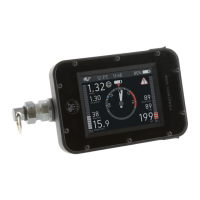
The next most important parameters to monitor are the gas supplies, represented as bar
graphs on the left and right sides of the Primary Display. In particular, it is important to make
sure that the Air (“DIL”) pressure graph is not ashing. The electronics system will constantly
calculate whether there is enough air supply remaining to allow a safe open-circuit bailout to
the surface. If there is not enough air to allow a safe open-circuit bailout to the surface, the “Up
Arrow” will be displayed on the Primary Display, indicating that the diver should ascend to a
shallower depth.
The oxygen supply pressure should also be monitored to ensure there is a sufcient quantity
of oxygen remaining in the oxygen cylinder to complete the remainder of the dive in closed-
circuit mode. Because these values change very slowly throughout the course of a typical
rebreather dive, there is a tendency to ignore them. As with other important parameters, there
will be warnings issued in case the oxygen supply pressure gets too low; but nevertheless, the
diver should be in the habit of monitoring this value regularly.
Monitoring remaining dive time
As mentioned previously, the Remaining Dive Time (RDT) value is based on several different
factors. The value displayed represents the amount of remaining time (in minutes) for the most
limiting factor. If the limiting factor is remaining battery capacity, the value will count down
consistently, regardless of depth. However, if the limiting factor is remaining oxygen supply, the
value could increase or decrease depending on the rate at which the diver is consuming
oxygen. The value can change even more dramatically (and suddenly) when the limit is based
on remaining no-decompression time. This is because a diver with only a few minutes remain-
ing at a depth of 30 meters (for example) may well have many more minutes remaining at a
shallower depth. Conversely, the remaining minutes may suddenly decrease sharply when
depth increases. Thus, it’s extremely important to monitor this value throughout the dive; par-
ticularly after increases in depth.
Note that the RDT value is NOT an exact value, and it should be regarded as a “recom-
mended” remaining dive time, rather than an absolute remaining dive time. In the event that a
diver inadvertently exceeds the no-decompression limits and the dive requires decompression
stop(s), the RDT value changes to display the remaining total decompression time, as described
previously.
Within the SE7EN there is an algorithm called CRA (consumables resource algorithm). The
algorithm keeps track of consumables like the battery, oxygen levels, no decompression and
diluent gas to surface. Using the algorithm the SE7EN calculates the remaining dive time.
Note: When conguring the rig for decompression diving, the CRA does not take the gas
volume requiered to safely ascent to surface in OC bailout mode nor the no decompres-
sion limits into consideration.


 To Next Page