PreSonus StudioLive
™
24.4.2
100
Quick Start:
Level
Setting
Overview Controls Scenes,
Presets &
System
Menu
Technical
Information
Tutorials Trouble-
shooting
& Warranty
Connecting
to a
Computer
Owner’s Manual
101
Quick Start:
Level
Setting
OverviewControlsScenes,
Presets &
System
Menu
TutorialsTechnical
Information
Trouble-
shooting
& Warranty
Software
Universal Control,
Capture, and
Studio One Artist
Hookup
Hookup
Software
Universal Control,
Capture, and
Studio One Artist
Connecting
to a
Computer
7.3 Capture
SOFTWARE: Universal Control, Capture, and Studio One Artist 7
Capture 7.3
7 SOFTWARE: Universal Control, Capture, and Studio One Artist
Suggestions Listen While Editing
In audio production, the editing process can be particularly
unforgiving. Small inaccuracies when splitting, moving, or performing
other actions on recorded audio can lead to unwanted results.
As simple as it may seem, the act of listening while editing is often
overlooked. For instance, when sizing the edges of a vocal part to
remove unwanted sounds between words, it is tempting to make the
edits based on the visual representation of the waveform. While this
may work sometimes, it is a much better idea to listen as you size the
events to be sure you are not removing any critical part of the vocals.
Listening to your edits as you make them will save
time and frustration in nearly every case.
7.3.8 Capture Session Navigation
The ability to quickly navigate to certain areas of your Session is
highly useful during the mixing process. The following describes the
ways in which you can quickly navigate throughout your Session.
Scrolling
To scroll left and right through time in your Session, click and drag
the horizontal scroll bar near the bottom of the Edit window.
Timeline Zooming
You can zoom in and out of your Session with respect to
time in the Edit window, so that you can look at the entire
length of the Session or just view a small region of time to
make accurate edits. To zoom, do one of the following:
Click and drag left or right on the Zoom scroll bar in the lower
right-hand corner of the Edit window to zoom in or out.
Press [W] on the keyboard to zoom out slightly. Press
[E] on the keyboard to zoom in slightly.
Click inside the Timeline ruler at any point in time
and drag down or up to zoom in or out.
Using Markers
In Capture, the Marker Lane is used to place markers at desired
places in the Timeline, after which navigation to the markers is
easy. Markers are also helpful when exporting your Session to
individual mixes or to work in another recording application.
The Marker Lane is always visible, just below the Timeline.
Inserting Markers
To insert a new Marker into the Marker Lane, with playback running or
stopped, click on the Add Marker button, or press [Insert] on the
keyboard. Each new marker will be numbered sequentially by default (#1,
#2, #3…). To rename a marker, double-click on the marker in the Marker
Lane, type in a new name, and then press [Enter] on the keyboard.
Navigating Markers
It is possible to quickly jump the Playback Cursor between markers in the
Marker Lane. Click on the Previous Marker button in the Transport, or
press [B] on the keyboard, to jump to the previous marker. Click on the
Next Marker button in the Transport, or press [N] on the keyboard, to
jump to the next marker. Jumping to markers during playback allows
quick comparisons between dierent sections of your Session.
Looping
To Loop the playback of any range of your Capture
session, do one of the following:
t Select an Event with the Arrow Tool, or select a Range
with the Range Tool, that you wish to loop. Press
[P] on the keyboard to set the loop range to your
selection. The range will be indicated by a bar drawn
in the timeline, with a left and right ag on either end.
t Mouse over the gray line above the time line.
You will notice that your curser changes to a
pencil tool and you can draw your loop range.
Once your loop range is set, you can click on the
Loop button in the Transport, or press [L] or [/]
on the keyboard to engage Loop mode. Start
playback before the end of the Loop range, and
when the end of the range is reached, playback
will jump back to the beginning of the Loop range
automatically for as long as Loop is engaged.
Engaging Record in the Transport will disable Loop Mode
and begin recording at the current playback cursor position.
It is not possible to engage Loop while recording.
7.3.9 Mixing in Capture
Mixing is the part of the production process where all
recorded tracks are combined to mono or stereo. The goal
is to balance relative volume, frequency, and dynamic
content in order to achieve a desired cohesive sound.
Mixing with Capture and StudioLive
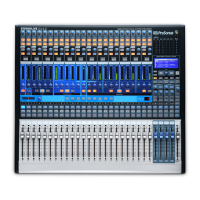
No mixing is done in Capture directly. Instead, the individual outputs
of each audio track in Capture are hardwired to the FireWire returns for





 To Next Page