PreSonus StudioLive
™
24.4.2
58
Quick Start:
Level
Setting
Overview Controls Technical
Information
Tutorials Trouble-
shooting
& Warranty
Scenes,
Presets &
System
Menu
Connecting
to a
Computer
Owner’s Manual
59
Quick Start:
Level
Setting
OverviewControlsTutorialsTechnical
Information
Trouble-
shooting
& Warranty
Scenes,
Presets &
System
Menu
Software
Universal Control,
Capture, and
Studio One Artist
Hookup
Hookup
Software
Universal Control,
Capture, and
Studio One Artist
Connecting
to a
Computer
System Menu 5.45.3 Graphic Equalizers
Scene, Presets, and the System Menu 55 Scene, Presets, and the System Menu
no frequency ripple. The StudioLive EQ is also capable of very sharp notches.
To widen a notch or a bump on a particular band, just bring the adjacent
bands closer to that band‘s gain and the bandwidth will change accordingly.
Making drastic adjustments too quickly, may create an audio artifact as the
new curve is redrawn and crosses over an audio peak. If you are hearing audio
artifacts while setting up your Graphic EQ, try creating a smoother curve.
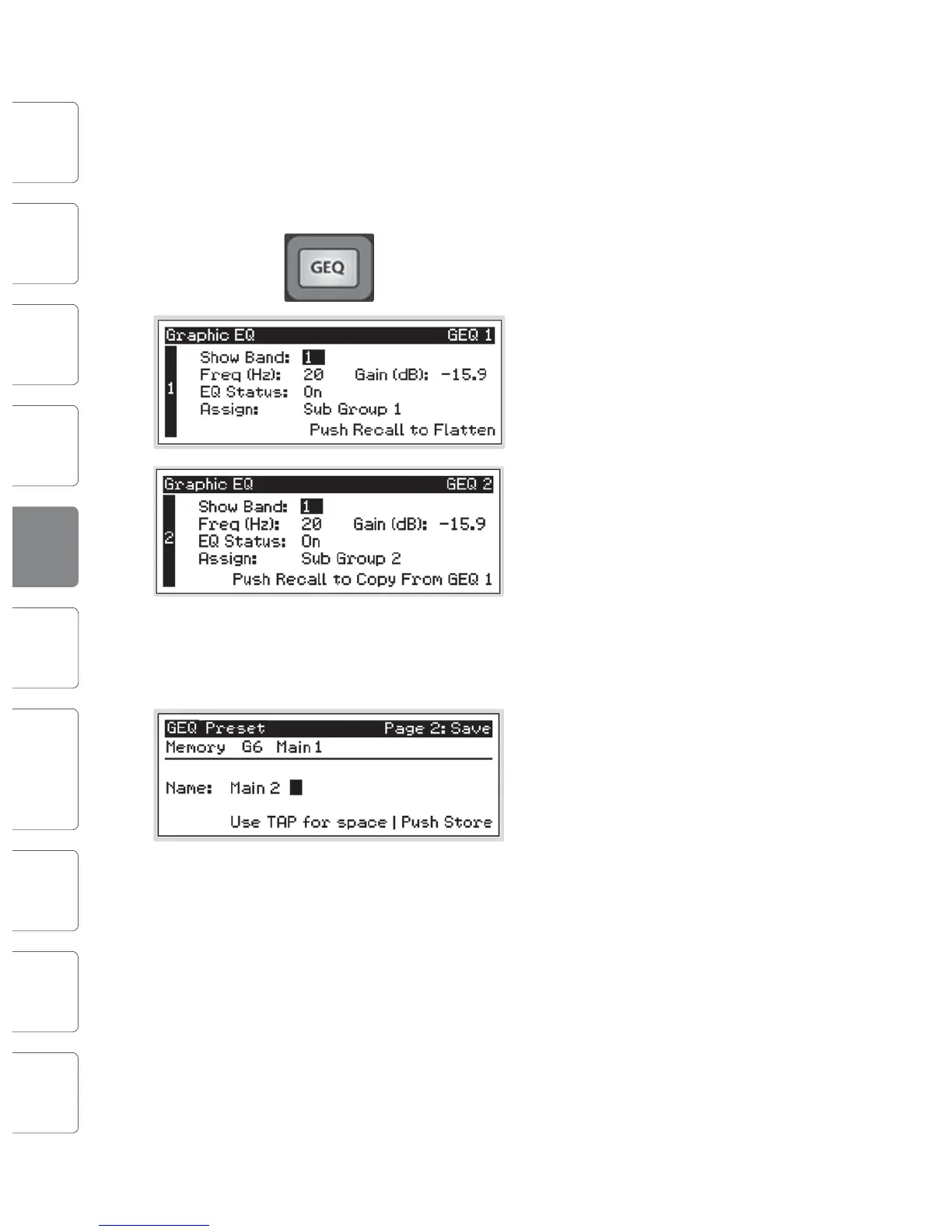
When you press the GEQ button on your StudioLive,
the Graphic EQ menu will be displayed on your LCD
screen There are 4 dual-mono (8 channels) Graphic
EQs in your StudioLive 24.4.2. These Graphic EQs are
assignable in stereo pairs. Each GEQ can be assigned
to the Mains, Subgroups 1-4, or Aux 1-10. The bus
assignment can only made from an odd-numbered
GEQ. The even-numbered GEQ will automatically be
assigned to the other half of the stereo pair. For
example, if you assign GEQ 1 to Subgroup 1, GEQ 2 will
automatically be assigned to Subgroup 2.
Each of the eight channels of Graphic EQ can be
controlled individually or odd-even pairs can be
controlled as a stereo unit. To copy the left side (odd)
GEQ settings to the right side (even), simply page
down to the ride side and press the Recall button.
Pressing the Recall button while using an odd
numbered GEQ will flatten it.
Use the Page Up and Page Down buttons to
navigate between Graphic EQs. Use the Next and
Prev buttons to navigate through each GEQ screen
and the Value knob to change a parameter
Like all other parameters on your StudioLive, your
Graphic EQ settings can be stored and recalled.
If you
have created a GEQ setting that you would like to save
to the GEQ Preset library, press the Save button in the
Fat Channel while that GEQ is active. You will notice
that the LCD will display the GEQ Save menu.
To begin, use the Value encoder to scroll to an empty position in the GEQ
Preset library. Press the Next button again to navigate to the rst letter of the
preset name. Turn the Value Encoder clockwise or counter-clockwise to change
the letter. The StudioLive allows you to customize the name with uppercase
and lowercase letters, as well as a selection of numerals and punctuation
marks. You can insert a space by simply pressing the Tap button. Once you
are satised with your changes, press the Store button. It will illuminate while
the GEQ preset is being written to the StudioLive’s internal memory. Once
the GEQ preset is saved, the Store button will return to its unlit state.
To load a preset to any channel on the StudioLive, rst
press the GEQ button and Page down to the desired
GEQ. From the Fat Channel, press the Load button. You
will notice that LCD now displays the GEQ Load menu.
Use the Value encoder to locate the preset you would
like to use.
Once you have made your selection, press the Recall button. If at any time you
would like to cancel this operation, simply press the Load button again.
5.4 System Menu
In most digital-console manuals, the phrase “System
menu” inspires a sense of dread. However, with the
StudioLive, you have nothing to fear. The System
menu on the StudioLive serves just a few simple
functions, most of which have very little to do with
mixing a show.
LCD Contrast and LCD Backlight.
Press the System button to access the System
menu. The rst page allows you to adjust the LCD
Contrast and LCD Backlight for optimal viewing
in your working environment. These settings
are retained when the unit is powered down.
Aux Pre Position.
Press the Page Down button to access the Aux
Pre Position page. By default, all 10 Aux buses
are set to Pre 1. This places the send of all 24
channels to each aux bus before the fader,
limiter, EQ, and compressor and after the phase-
reverse switch, high-pass lter, and noise gate.
The 2 internal eects buses are set to Pre 2, which routes each of the 24 channels
after all Fat Channel dynamics and EQ but pre-fader. From this menu, you can
choose between these two Pre positions for each Aux mix. If you have two Aux
buses stereo linked, you only need to set the Pre position on the Link Master.
Remember, the Link Master is the aux that was selected when the link was created.
To nd out which Aux is the Link Master, simply select either of the Aux buses in
the pair. The Link Master‘s ID will be shown in the Select Channel LED readout.





 To Next Page