2–3
Principles of Operation
Line Matrix Printing
The 9212 creates characters and graphics by a printing technique called line
matrix printing. Line matrix printing consists of printing patterns of ink dots
on paper, an entire line at a time.
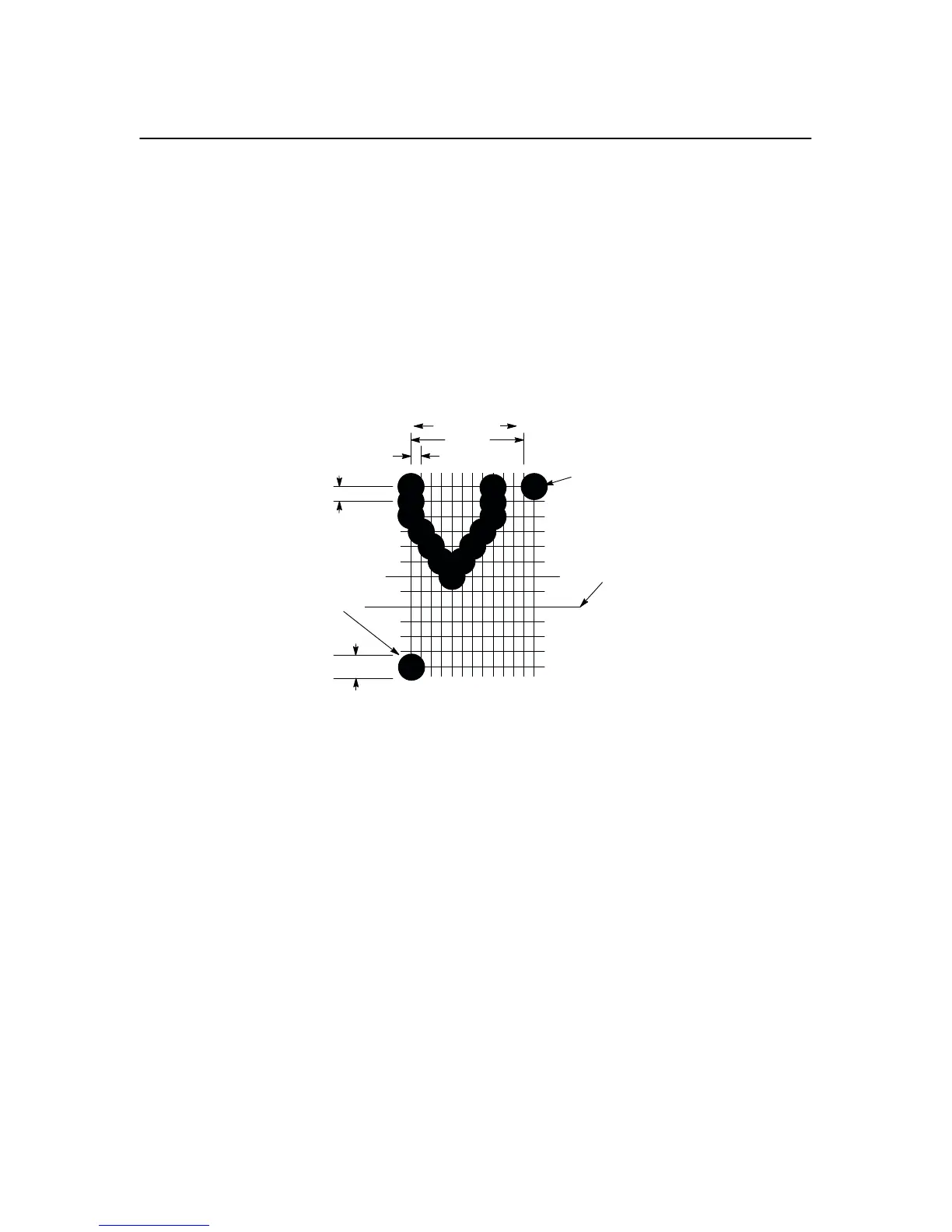
Each text character is stored in memory as a pattern of dots on a logical grid
called the dot matrix. (See Figure 2–1.) The actual ink dots are made by a
row of hammer springs mounted on a shuttle that sweeps rapidly back and
forth. Printer logic divides every printable line into horizontal dot rows. The
hammer springs put dots at the required positions for the entire line by
striking a moving ink ribbon and the paper.
112
Column No.
0.10
0.00835
0.01389 ”
0.02 ”
”
”
First row and column
of next character.
Lowest descender
dot line.
First row and column of
next character line (at 6
LPI).
Figure 2–1. A Dot Matrix
When the shuttle reaches the end of a sweep, it reverses direction, the paper
is advanced one dot row, and the hammer springs print the next row of dots
as the shuttle sweeps in the opposite direction. After a line of characters is
printed, hammer action stops and the paper advances to the first dot row of
the next print line. The number of dot rows allowed for line separation
depends on the vertical line spacing the user selects.
The dot patterns of characters vary according to the font selected. For
example, in the data processing (DP) font at a line spacing of six lines per
inch (lpi), the dot matrix contains 12 dot rows from the top of one character
line to the top of the next. (See Figure 2–1 and Figure 2–2.) At eight lpi there
are nine dot rows per character line, at nine lpi eight dot rows per character
line, and so on.



 To Next Page