Installation and operating instructions
27 Vers. 1.0 2024_03
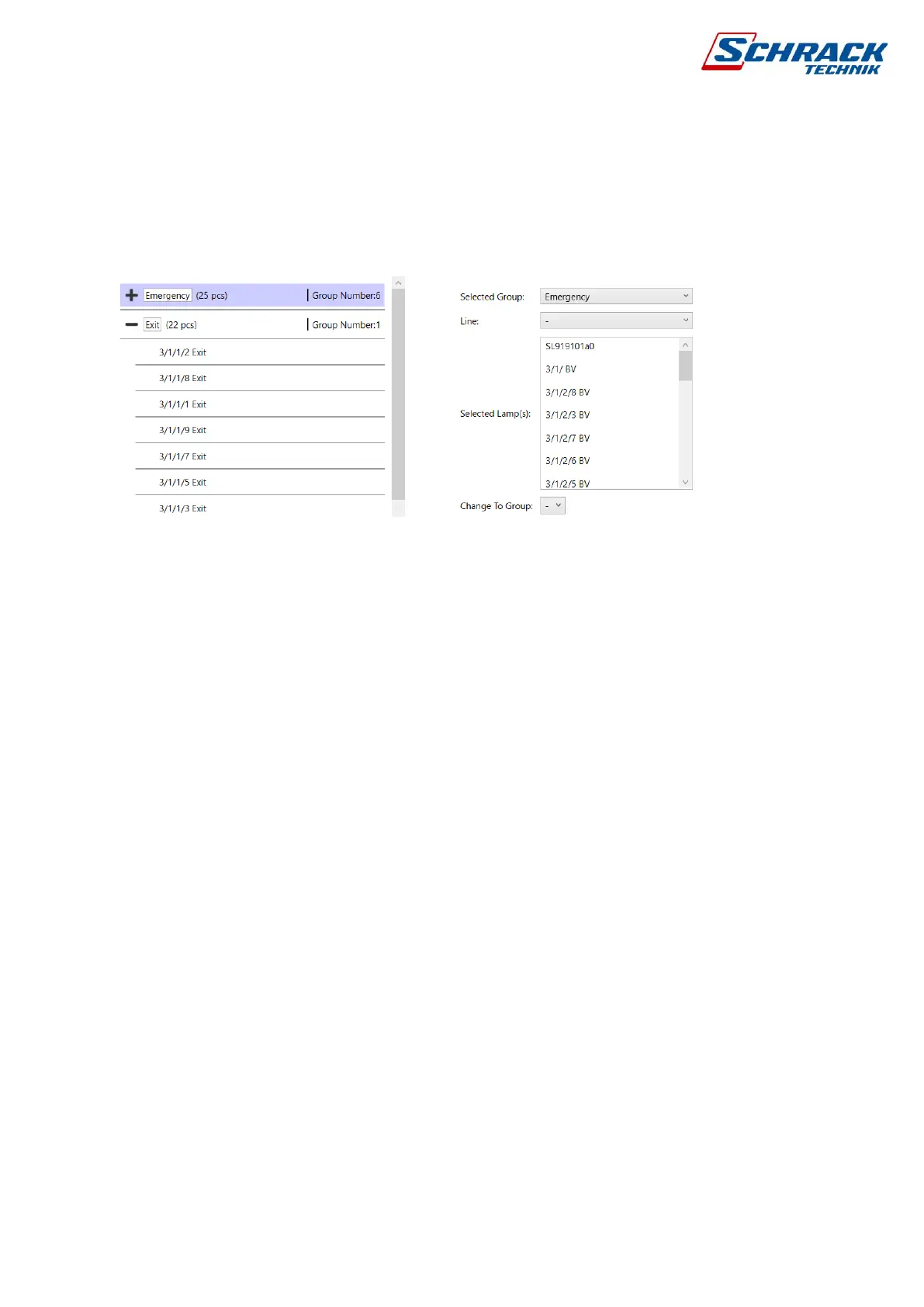
Grouping plays an important role in the split switching of luminaires, when we want to control
only luminaires in one area with the signal of the AC control supervising the distribution cabinet.
You can create groups that can be controlled jointly over more networked centrals, all you have
to do is assign the luminaires to a group with the same number on each control panel.
To control dynamic luminaires (which are able to change the direction of the arrow), fire groups
must be created, which are assigned to a fire compartment signal.
Group Manager
4.2.5 Calibration / Test
In order for the system to be able to detect the fault of the LED light source of the luminaires
during the tests, it is necessary to initially measure the current consumption. The calibration
command should be sent to all luminaires at once, but it is also possible to assign it to a group
or even to a single luminaire.
Calibration takes 1 minute, followed by the collection of results, which is roughly equal to the
reading speed of the luminaires. The process can end with 3 kinds of results: the measured
value is correct, the current flow on the LED is 0mA or the luminaire is not able to respond.
You can check the result from the list of events, and in case of an error, you can start the
correction in a targeted way, because the system refers to the name of the luminaire.
Once all the lights have been successfully measured (calibrated), you can carry out a short
test (function test) or a long test (capacity test). During the function test, the lights are switched
on for a few seconds and the measured power consumption value is compared with the
reference value measured during calibration. If this is within the tolerance, the light is
considered to be working properly. During the duration test, a function test is started first, then
the system switches to battery operation for the entire duration of the test and starts
discharging the battery under full load. If the battery voltage is >21V at the end of the test, the
test is successful. The battery voltage measured at the start and end of the test is saved.
Of course, these tests can also be set to an automatically recurring time period.



 To Next Page