•
Parameter setting by the host for the configuration of the device
•
Parameters and status log querying by the host.
•
Requests for contour measurement values by the host, subsequent response from
the device
Each telegram comprises a frame and the application data.
NOTE
USP command is available for the LD-LRS3601/3611 only.
A detailed description of the different telegrams can be found in telegram listing no.
8016687 and 8016855 on the product page.
The call is made via the SICK Product ID: pid.sick.com/{P/N}/{S/N}
{P/N} corresponds to the part number of the product, see type label.
{S/N} corresponds to the serial number of the product, see type label (if indicated).
Frame and coding of the telegrams
The payload varies depending on the coding.
Table 5: Frame of the telegrams when using ASCII coding (CoLa-A)
Frame Telegram Frame
Designation STX Payload ETX
Length (Byte) 1 ≤60kB 1
Description Start of text char‐
acter
ASCII coded End of text charac‐
ter
3.4.11.3 Digital output
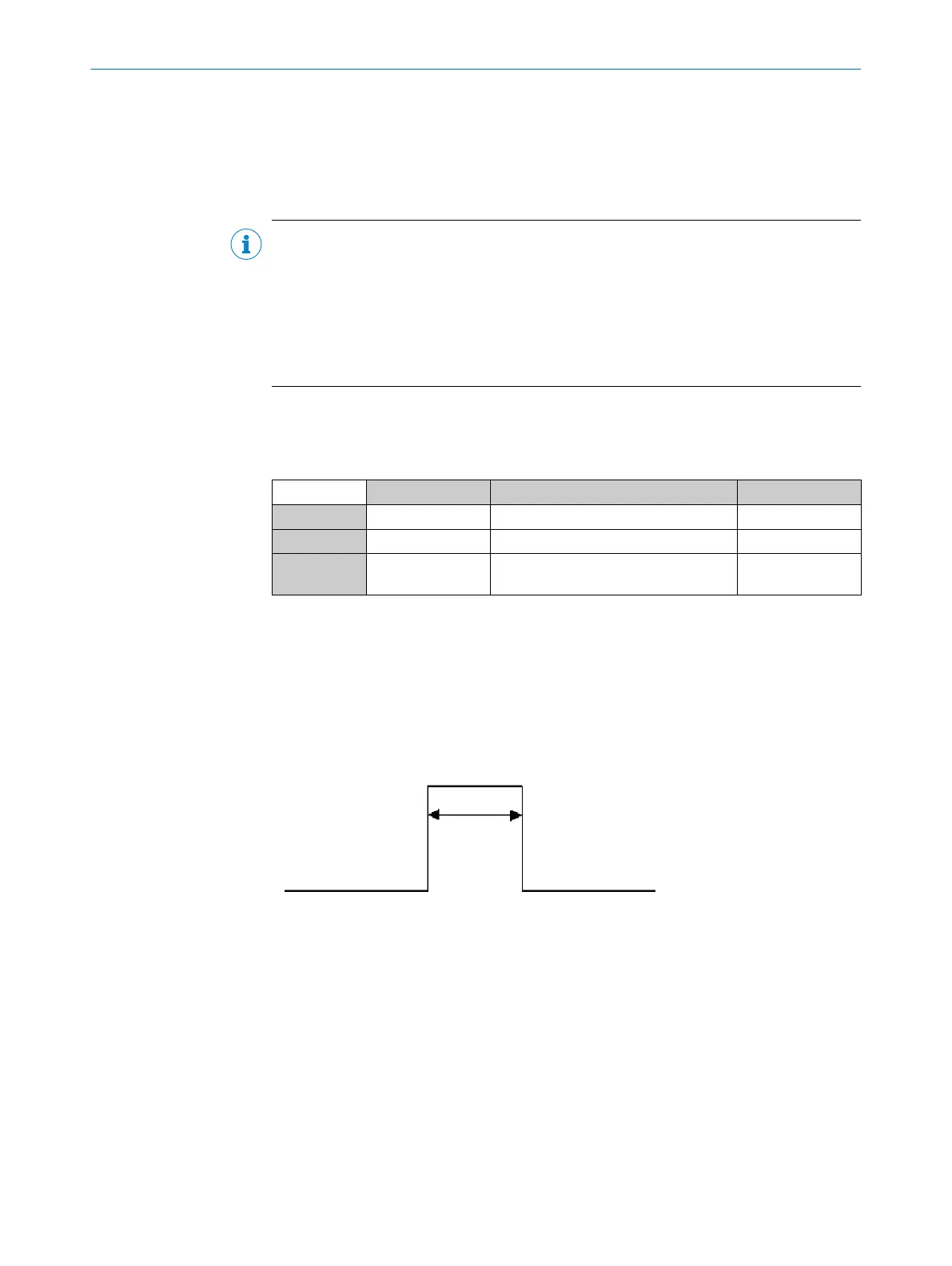
The device has a digital output which is used to synchronize the internal clock of the
device and that of the external computer. Depending on the synchronization method,
the output provides a 10ms pulse or a pulse dependent on the rotational frequency
(see "Synchronization of the external clock and device clock", page 21). The pulse is
output depending on the synchronization method.
Figure 13: Synchronization pulse
1
min. 10ms
3.4.11.4 Synchronization of the external clock and device clock
For precise control, the contour data of the device and the calculations in the external
computer must be synchronized as accurately as possible in time.
The measurement data from the device is provided with the internal time stamp. The
internal time stamp in the device is a 32-bit counter which increases in increments of 1
every 1ms.
PRODUCT DESCRIPTION 3
8016506/1G07/2020-11-08 | SICK O P E R A T I N G I N S T R U C T I O N S | LD-LRS
21
Subject to change without notice


 To Next Page