EasyManua.ls Logo

SICK OD1000 - User Manual

SICK OD1000
68 pages
Print Icon
To Next Page IconTo Next Page
Loading...
O P E R A T I N G I N S T R U C T I O N S
OD1000
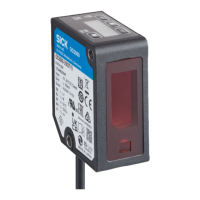
Displacement measurement sensor

Table of Contents

Questions and Answers

  • J
    Jason MorenoAug 1, 2025
    How to troubleshoot SICK OD1000 Accessories device not displaying a measurement?
    • J
      jhartAug 1, 2025
      If your SICK Accessories device isn't displaying a measurement, first ensure the device laser is activated and pointing at the object within its measuring range. Also, use SOPAS ET (user level required) to check the light distribution curve. This curve indicates if the device's receiver element is receiving light, typically showing a maximum within the displayed area, visualizing light remission onto the receiver element.
  • C
    Connie RobinsonAug 4, 2025
    What to do if SICK OD1000 operating temperature is undershot or exceeded?
    • A
      anita92Aug 5, 2025
      If the operating temperature of your SICK Accessories is too low or too high, check the surrounding ambient temperature. Adjust it accordingly to ensure it falls within the specified operating range.
  • L
    larrythomasAug 9, 2025
    Why does my SICK OD1000 display a warning triangle?
    • K
      Krista FullerAug 9, 2025
      A warning triangle on the SICK Accessories display indicates a potential issue. Possible causes include an obstructed light path, the device being outside of its measuring range, or a highly reflective surface interfering with the measurement.
  • B
    bfloresAug 13, 2025
    What to do if SICK Accessories has no measurement possible?
    • H
      heidigreenAug 14, 2025
      If your SICK Accessories can't take measurements, verify the measuring range and try reducing the distance to the object. You might also try increasing the cycle time setting.
  • L
    Lindsay HartmanAug 17, 2025
    What to do if SICK OD1000 has an operating fault?
    • B
      Brenda ArmstrongAug 17, 2025
      If your SICK Accessories reports an operating fault, examine the electrical environment. Improve stability, voltage supply, and reduce EMC influences if needed.
  • V
    vbutlerAug 22, 2025
    What to do if SICK Measuring Instruments device does not display measurement?
    • C
      Caitlyn KingAug 22, 2025
      If your SICK Measuring Instruments device isn't displaying measurements, several factors could be at play. First, ensure the device's laser is activated and correctly aimed at the object. Obstructions in the light path, or the object being outside the device's measuring range, can also cause this issue. Insufficient light reaching the receiver element or reflective surfaces might also be the cause. Check the light distribution curve in SOPAS ET (available in the Advanced user level) to see if the receiver element is receiving enough light. Also, consider checking the surface characteristics of the object.
  • K
    Karen MartinAug 27, 2025
    What to do if SICK Measuring Instruments displays warning triangle and measurement is not possible?
    • E
      Evan SmithAug 27, 2025
      If your SICK Measuring Instruments device is showing a warning triangle and you can't get a measurement, it could be due to a few reasons. Make sure the light path isn't blocked, and that the object you're measuring is within the device's specified range. Also, specular surfaces may cause this problem, so check the surface characteristics of the object.

Summary

Safety Information

2.1 Intended Use

Describes the product's purpose as an opto-electronic distance measuring device.

2.2 Improper Use

Details prohibited uses and conditions that constitute incorrect product operation.

Product Description

Mounting

Electrical Installation

6.1 Safety

Crucial safety warnings regarding electrical connections and supply voltage.

6.3 Connecting the Device Electrically

Detailed instructions on making the electrical connections to the device.

Operation

Operation via Display

8.1 Menu Structure and Parameter Description

Overview of the device's menu structure and parameter settings.

8.1.2 Measurement Menu Group

Describes the menu structure for measurement-related settings.

8.1.3 I;O Interface Menu Group: Q1 Output

Details the configuration options for the Q1 output interface.

8.1.4 I;O Interface Menu Group: Q2;Qa Output, In1 Input

Explains settings for Q2/Qa output and In1 input interfaces.

8.3 Measurement

Overview of measurement functions and parameters.

8.4 I;O Interface

Overview of input/output interface functionalities.

Teach-in

Teaches a switching point by setting the current distance.

8.4.1.5 Alarm

Outputs a constant signal when no measurement is possible.

8.4.1.7 Edge Height Change

Function for detecting changes in measured values for applications like counting.

8.4.3.1.3 Teach-in

Details teach functions using signal levels at the In1 input.

8.3.1 Application Settings

Configuration of application-specific measurement parameters.

8.4.1 Q1 Output

Details the functions and modes of the Q1 switching output.

Manual Teach-in

Manually sets the switching point distance.

8.4.1.6 Signal Level Warning

Outputs a warning if the signal level drops below a specific value.

8.4.2 Q2;Qa Output

Details configuration for Q2/Qa output as analog or switching.

8.4.2.1.1 4-20 mA Output Function

Configures the Q2/Qa output as a 4-20 mA analog current output.

Operation via Display

8.3.1.1 Distance Range

Defines the evaluation range for measuring object distances.

8.3.1.2 Edge Height Change

Configures output signals based on changes in measured values.

8.3.2 Default Settings

Overview of default parameter configurations for various functions.

8.3.2.2 Measured Value Filter

Explains filters for optimizing signal diagrams and signal evaluation.

8.3.2.3 Bit Filter

Determines how often an output state must recur before changing.

8.3.2.4 Measuring Direction

Changes the sign of the relative distance value based on direction.

Teaching in the Zero Point

Teaches the current distance as a new zero point or reference point.

8.4.1.3 Window

Sets upper and lower thresholds for outputting a signal within a window.

8.4.1.4 ObSB (Object Between Sensor and Background)

Detects objects by teaching the background as a reference.

8.3.2.1 Cycle Time

Defines the interval for measurements and output rate.

8.3.2.5 Measured Value Offset

Moves the zero point to measure absolute distance changes relative to a reference.

Resetting the Zero Point

Resets the zero point to the factory setting.

8.4.1.2 Distance to Object (Single Switching Point)

Configures output signal based on distance exceeding or undershooting a point.

8.3.2.6 Action in Case of Incorrect Measurements

Configures device behavior when no measurement is possible.

Operation via Display

Operation via IO-Link

Operation via SOPAS ET

Maintenance

Troubleshooting

12.1 General Faults, Warnings, and Errors

Categorizes and describes common faults, warnings, and errors.

12.2 Detecting and Displaying Errors

Explains how errors are detected, displayed, and stored in the error memory.

Technical Data

Technical Data

SICK OD1000 Specifications

General IconGeneral
BrandSICK
ModelOD1000
CategoryAccessories
LanguageEnglish

Related product manuals