Configuring / Programming
9.5 Configure BACnet client
PN/BACnet LINK
72 Operating Instructions, 10/2017, A5E39895543-AA
4. Use the check boxes ③ to specify the BACnet device objects to be transferred.
The hierarchy arrow
④ indicates that I/O objects are contained in the BACnet device. By
clicking on the arrow, you can display the assigned I/O objects and select or deselect
individual I/O objects.
Note
Only object types supported by PN/BACnet LINK (BI, BO, AI and AO) are displayed here.
5. To transfer the selected objects to the configuration of the PN/BACnet LINK currently
active in the project, click the "Add selected objects" button
⑤. The imported BACnet
devices are now transferred and automatically inserted into the configuration.
Creating object references manually
Object references are created manually by inserting a generic BACnet device from the HW
catalog into the PN/BACnet LINK. After setting the appropriate instance number for the
associated device object, you can configure references to the I/O objects contained in this
device object.
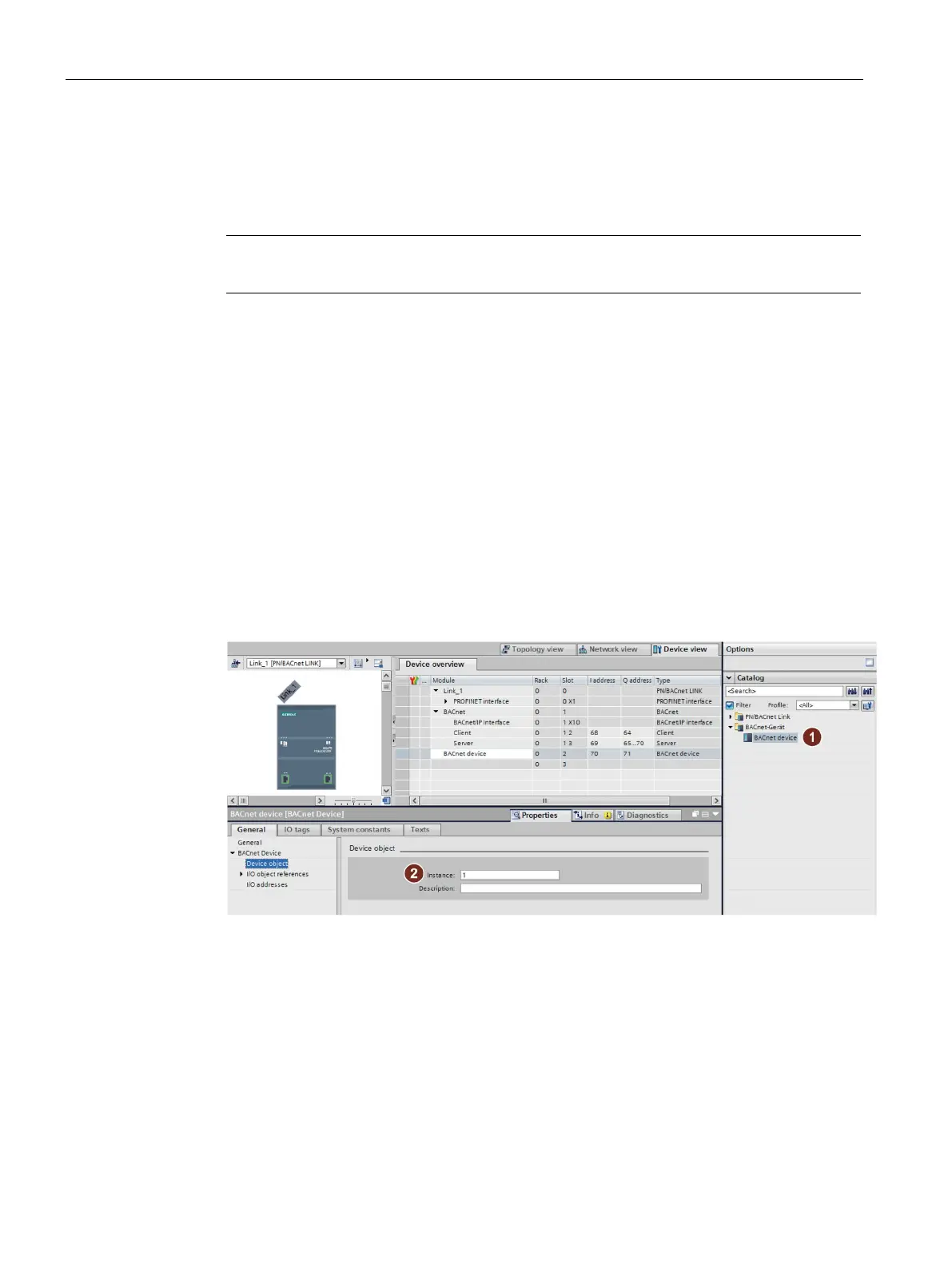
1. Double-click "BACnet device" ① In the HW catalog. This places a BACnet device as a
submodule in PN/BACnet LINK.
Figure 9-15 Insert BACnet device
2. Enter the instance number ② for the device object. The specification of the instance
number is used to uniquely identify the device. The instance numbers of all device
objects in a BACnet network must be unique.
The instance number must correspond to the device that contains the objects to be read
or written.



 To Next Page