c) The model cooling fan cannot be turned on when some models are printed.
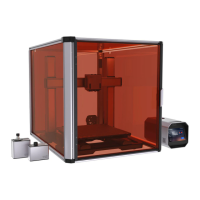
2. Some filaments require high ambient temperature during printing, so the cover door should
be closed and the top panel should be fixed during printing.
Filaments can not be extruded or extruded insufficiently
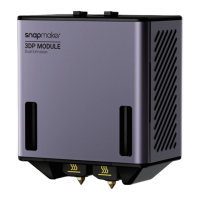
The nozzle may be partially or completely blocked when the filament cannot be extruded from
the nozzle at all (at this time, the touchscreen may pop up a window indicating "unable to
extrude"), the extruded filament is thinner than usual, or the surface of the filament is
uneven.
Possible causes
1. The quality of filaments is not up to standard.
2. An unsupported filament type was used.
3. Improper setting of the printing temperature.
4. Nozzle and extruder gear are not cleaned in time during daily use.
5. Inner cavity temperature is too high when printing with PLA filaments.
Solution
1. You can take the following measures to avoid nozzle clogging:
a) Before printing, check the filaments for quality problems such as moisture (see How
to identify damp filaments). If any, dry the filament or replace it with a new
filament and try again.
b) Before printing, check if the filaments used for printing are within the support range
of Snapmaker J1 (refer to the filaments library).
c) Set the correct printing temperature according to the information provided by the
filament manufacturer.
d) Periodically clean the nozzles and the extruder gears.
e) The heat distortion temperature of most PLA filaments is between 50 ℃ and 60 ℃.
When using PLA filaments for printing, it is necessary to remove the top panel,
otherwise the temperature in the inner cavity of the printer may be too high, which
will cause the filaments to soften in advance and can not be extruded smoothly.
2. When the nozzle has been blocked, you can take the following methods to dredge:
a) Have a needle with a diameter smaller than the current nozzle diameter. The provided
nozzle diameter is 0.4mm.


 To Next Page