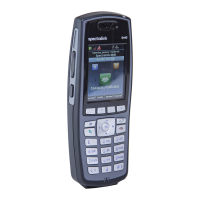
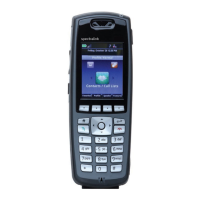
Spectralink 84-Series Series Wireless Telephones Administration Guide
1725-86984-000_P.docx
September 2016 248
dialplan.removeEndOfDial
1
If set to 1, strip trailing # digit from digits sent out.
dialplan.routing.emergency.outboundIdentity
SIP, secure SIP, or TEL
URI
The identity used to identify your handset when you place an emergency call from your handset. A valid SIP,
secure SIP, or TEL URI. The string may be 10 to 25 characters in length.
dialplan.routing.emergency.x.description
1
Emergency contact description
dialplan.routing.emergency.x.server.y
1
Emergency server
dialplan.routing.emergency.x.value
Emergency URL values
string
positive integer
SIP URL (single entry)
x=1:Emergency, Others: Null
x=1: 1, others: Null
x=1: 911, others: Null
x is the index of the emergency entry description and y is the index of the server associated with emergency entry
x. For each emergency entry (index x), one or more server entries (indexes (x,y)) can be configured. x and y must
both use sequential numbering starting at 1.
description: The label or description for the emergency address
server.y: The index representing the server to use for emergency routing
(dialplan.routing.server.x.address where x is the index).
value: The URLs that should be watched for. When the user dials one of the URLs, the call will be directed to the
emergency server defined by address.
Note: Blind transfer for 911 (or other emergency calls) may not work if registration and emergency servers are
different entities.
dialplan.routing.server.x.address
1
dotted-decimal IP address
or hostname
The IP address or hostname of a SIP server that will be used for routing calls. Multiple servers can be listed
starting with x=1 to 3 for fault tolerance. Note: Blind transfer for 911 (or other emergency calls) may not work if
registration and emergency servers are different entities.
dialplan.routing.server.x.port
1
The port of a SIP server that will be used for routing calls
dialplan.routing.server.x.transport
1
DNSnaptr, TCPpreferred,
UDPOnly, TLS, TCPOnly
The dns lookup of the first server to be dialed will be used, if there is a conflict with the others.
For example, if dialplan.routing.server.1.transport="UDPOnly" and
dialplan.routing.server.2.transport = "TLS", then UDPOnly is used.
1
Change causes handset to restart or reboot.
Per-registration dial plan configuration is also supported. The descriptions for each parameter
are in the table below. The parameters listed in this table overrule the parameters in the
previous table for registration x, where x is the registration number (for example,
dialplan.x.applyToTelUriDial overrules dialplan.applyToTelUriDial for
registration x):
Table 10-7: Per-Registration Dial Plan (Digit Map) Parameters
dialplan.x.applyToCallListDial
1
dialplan.x.applyToDirectoryDial
1
dialplan.x.applyToForward


 To Next Page
 Loading...