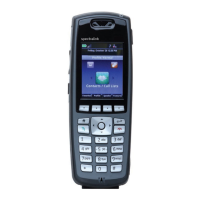
Spectralink 84-Series Series Wireless Telephones Administration Guide
1725-86984-000_P.docx
September 2016 39
2.4 GHz Menu
You can modify the following parameters from the 2.4 GHz menu:
Table 3-6: 2.4 GHz Menu
A flag to determine if the 2.4 GHz band is enabled.
The maximum power that the handset uses to transmit in the 2.4 GHz sub-band. The “7” setting is also called Auto
in some menus. If no maximum is set, the handset uses the P5 settings for each channel activated. Note that ESTI
regulations limit the maximum setting in Europe. If P4 or above is selected for domain 2, the handset will
broadcast at the maximum allowable power which is 12 mW.. For more information, see the
device.wifi.radio.band2.4GHz.subBandx.txPower set of parameters in Appendix D.
USBNet Menu
You can modify the following parameters from the USBNet menu:
Table 3-77: USBNet Menu
A flag to determine if USB networking is supported. USBnet is used by SLIC and USB Setup for initial provisioning.
SLIC disables it when the files are produced. Parameter: device.usbnet.enabled
Dotted-decimal IP address
The handset’s dotted-decimal IP address on the USBNet interface. For Spectralink handsets, the default value is
169.254.1.2 .
Dotted-decimal subnet mask
The handset’s subnet mask. For Spectralink handsets, the default value is 255.255.0.0 .
Dotted-decimal IP address
The handset’s default router. For Spectralink handsets, the default value is 169.254.1.1 .
If enabled, DHCP will be used to obtain the parameters discussed in DHCP or Manual TCP/IP Setup.
Syslog Menu
Syslog is a standard for forwarding log messages in an IP network. The term ‘syslog’ is often
used for both the actual syslog protocol, as well as the application or library sending syslog
messages.
The syslog protocol is a simple protocol: the syslog sender sends a small textual message (less
than 1024 bytes) to the syslog receiver. The receiver is commonly called ‘syslogd’, ‘syslog
daemon’ or ‘syslog server’. Syslog messages can be sent through UDP, TCP, or TLS. The data
is sent in cleartext.


 To Next Page