pg 35
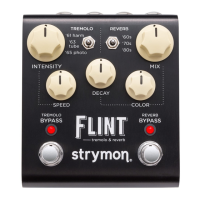
Flint - tremolo & reverb
Features
• Hand crafted tremolo & reverb algorithms inspired by classic
systems
• Three Tremolo types: ‘61 harmonic, ‘63 tube bias, and ‘65
photoresistor
• Three Reverb types: ‘60s spring, ‘70s electronic plate, and ‘80s rack
• Five Live Edit, secondary parameters: Tremolo Boost/Cut, Reverb
Boost/Cut, Tap Division, Effect Order, and Reverb Pre-Delay
• Individual Tremolo and Reverb On/Off footswitches
• Ultra low Noise, high performance A/D and D/A converters
• +10dBu maximum input level easily handles instrument and line
signals
• Expression pedal input allows the connection of a TRS expression
pedal, MiniSwitch, MultiSwitch Plus, or TRS MIDI connection
• Full featured MIDI accessible via TRS supporting MIDI CCs, MIDI
clock sync, access to 300 preset locations (requires Strymon MIDI
EXP cable or MIDI > TRS interface such as Strymon Conduit)
• USB-C jack for controlling via MIDI from a computer or for perform-
ing potential future firmware updates
• High performance 520MHz ARM Superscalar processor
• 32-bit floating point processing
• Stereo input (requires TRS adapter cable) and stereo output
• High impedance ultra-low noise discrete Class A JFET preamp
inputs
• Low impedance stereo outputs
• True bypass (electromechanical relay switching)
• Strong and lightweight anodized aluminum chassis
• Designed and built in the USA


 To Next Page