Istruction Manual for Operation and Maintenance SPX-960:
The wire rope supervisor and tester must be qualifi ed to understand the causes of possible breakage or
damage to the rope: he must be able to understand if the rope is in good operating condition or if it needs
to be replaced.
The wire rope supervisor is also responsible for the following:
- he assists wire rope installation after making sure that it has been lubricated properly and is suitable for
the application on which it is installed;
- he records the wire rope specifi cations, the installation date and the max. number of admissible wires in
the equipment inspection book;
- he trains personnel on wire rope installation;
- he trains machine operators on start-up operations (low speed, reduced loads, no jerking);
- he ensures that the wire rope is suitable with the winding drum after one week from installation and
checks the anchoring devices and end locks;
- he checks for possible problems after one month from installation;
- he checks the wire rope conditions periodically, i.e. every three months, or at shorter intervals depending
on the rope conditions;
- he fi xes anchoring devices, if and as needed;
- he services any equipment malfunctioning such as no engagement of the anti-two block switches, wire
rope release from the drums or pulleys.
WARNING
The wire ropes must be replaced every 1500 hours. funi.
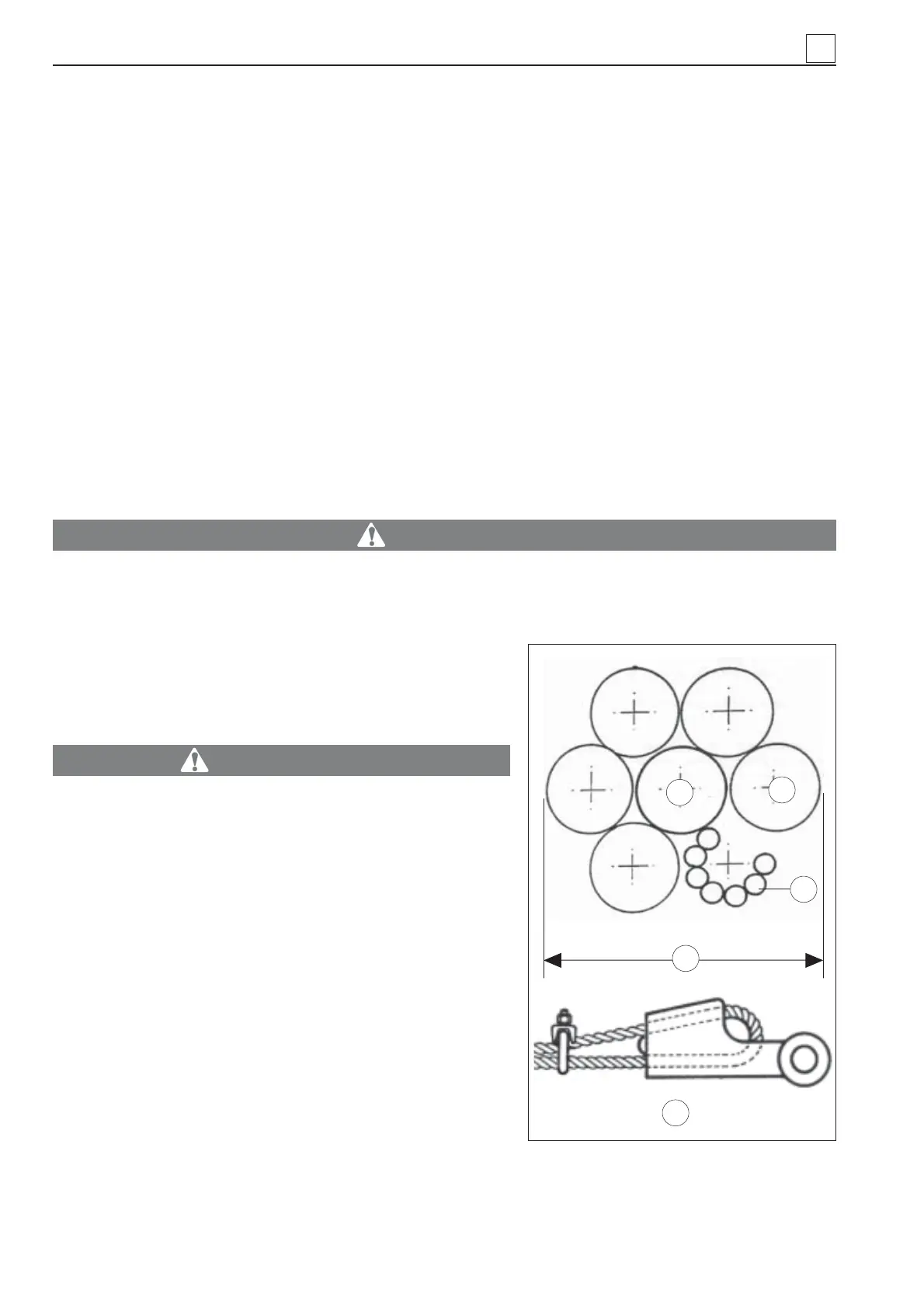
Small grooves cause wire rope deformations and excessive contact between the rope elements (strands
and core - Fig. 54): this may jeopardize wire rope performance
and duration. The wire rope duration is also affected by groo-
ve wear. For instance, if the groove is excessively scored or
deformed, the wire rope is more likely to get worn.
DANGER
The wire rope is wound on parts which are specifi cally
sized according to the rope diameter. For this reason, it
is not recommended (due to more rapid wear) and it is
dangerous to use different wire rope diameters from those
indicated by the manufacturer.
5.2.6 WIRE ROPE MAINTENANCE
Constant maintenance and periodic checks guarantee proper
preservation of the wire ropes. Other precautions for wire rope
preservation are:
1) do not put the rope on muddy or dusty soil;
2) handle the wire rope with gloves;
3) do not clean the wire ropes with petrol or other solvents:
these fl uids penetrate into the rope and may damage the
core, because they remove the natural oils inside the wire
rope;
Fig. 54
1) Wire rope core. - 2) Wire rope strand. - 3)
Wire rope. - 4) Wire rope diameter. 5) Wire
rope terminal clamp.
1
2
3
4
5
5
5-8
MAINTENANCE


 To Next Page