41
User’s manual
2.3.1.3.3 KINETIC ENERGY DISSIPATION ON BREAKING
RESISTANCE
The standard solution for the OPEN drive is the dissipation of kinetic Energy on braking resistor. All
the OPEN drives are equipped with an eternal braking circuit, while the braking resistor must be
connected externally, with the appropriate precautions.
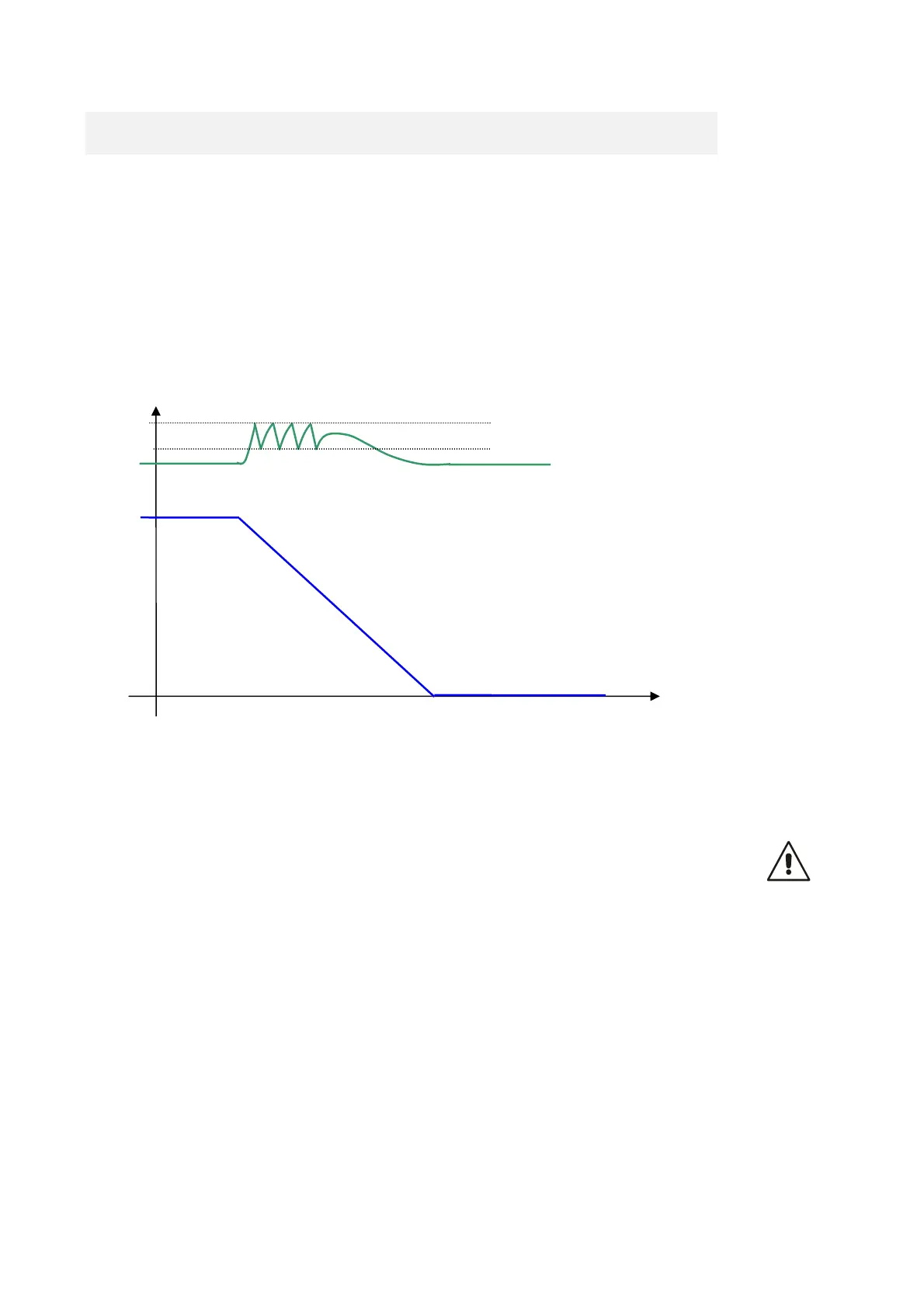
With this solution, the Bus’ maximum level of voltage becomes limited through a power device that
connects in parallel the resistor with the DC Bus capacitors, if the voltage exceeds the threshold
value in P108, the drive keeps it inserted until the voltage goes below the value of P109; in such a
way, the energy that the motor transfers onto the DC Bus during the braking, is dissipated from the
resistor.
This solution guarantees good dynamic behavior also in braking mode.
In the follow figure it’s shown the Bus voltage and the speed during a dissipation on breaking
resistance.
A maximum voltage limit allowed exists for the DC Bus voltage. This is checked by the software
(threshold P107), and by the hardware circuitry: in case the voltage exceeds this level, the drive will
immediately go into an over voltage alarm A11 to protect the internal capacitors.
In case of A11 alarm condition starts, verify the correct dimensioning of the braking resistor power.
Refer to the installation manual for the correct dimensioning of the outer braking resistor.
The braking resistor may reach high temperatu
es, therefore appropriately place the
machine to favor the heat dissipation and prevent accidental contact from the operators.
speed
Energy dissipation on
breaking resistor
DC bus voltage
P10
P10



 To Next Page