Operation
Alarm Output Specifications
Please note the following considerations when using the analog output
feature.
WARNING
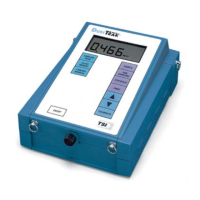
The DUSTTRAK monitor Alarm Output function should not
be used to detect hazardous conditions or to provide an
alarm for protecting human life, health or safety.
• The alarm output function default status is “Off.” You must activate
this function and set the alarm level, before using the alarm output
(see section below, on programming the Alarm Output).
• You must supply your own powered alarm system. The D
USTTRAK
monitor only contains a switch that closes (activates) the alarm,
when the detected levels exceed the threshold.
• The user alarm must be DC-powered only! The alarm system must
not exceed a maximum supply voltage rating of 15 VDC or a
current draw of 1 amp.
Caution
The alarm switch must not be wired to AC power! Failure
to properly install the user alarm could damage the
D
USTTRAK instrument and/or void the instrument
warranty! Please read and follow all instructions before
wiring or operating the user alarm.
• The alarm switch contained within the D
USTTRAK monitor has an
electrical polarity. It must be wired with the supply voltage
connected to the positive pole. If the user alarm is wired with
reverse polarity, it will not function properly.
• The alarm threshold must be set between the values of 0.002 and
100 mg/m
3
.
• The alarm switch will turn on the instant the setpoint is reached. It
will remain “latched” for a minimum of 5 seconds.
• While the alarm is triggered, the D
USTTRAK monitor’s internal
beeper will sound once per second, and the display will alternately
exhibit the characters “AL” to indicate an alarm condition.
• The alarm switch will turn off when the measured concentration
falls 5% below the setpoint (dead-band).
• The alarm output function operates totally independently of the
analog output.

 To Next Page
 Loading...