37
Chapter 4
Maintenance
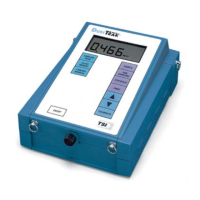
The D
USTTRAK monitor can be maintained and calibrated in the field using
the instructions below. Even so, TSI recommends that you return your
D
USTTRAK monitor to the factory for annual calibration. For a reasonable
fee, we will quickly clean and calibrate the unit and return it to you in “as
new” working condition, along with a Certificate of Calibration. This
“annual checkup” helps ensure that the D
USTTRAK monitor is always in
good operating condition.
The D
USTTRAK monitor is factory calibrated to the standard ISO 12103-1,
A1 test dust (formerly Arizona Test Dust). The calibration data is stored
internally and cannot be accessed by you. This standard test dust is used
because of its wide particle size distribution. This makes the internal
calibration representative of an average of most types of ambient aerosol you
might encounter.
For many applications, the factory calibration provides accurate
measurements. There may be times when more accurate mass concentration
data is needed because the aerosol being sampled is significantly different
than the standard ISO test dust. To accommodate such a measurement, the
D
USTTRAK monitor has been designed to allow for field calibration.
Note: There are no user-serviceable parts inside this instrument. TSI
recommends that you return the D
USTTRAK monitor to the factory
for any required maintenance or service not described in this
manual.
Maintenance Schedule
Your Model 8520 D
USTTRAK Aerosol Monitor requires maintenance on a
regular basis. Table 4–1 lists the factory recommended maintenance
schedule.
Some maintenance items are required each time the D
USTTRAK monitor is
used or on an annual basis. Other items are scheduled according to how
much aerosol is drawn through the instrument. For example, cleaning the
inlet sample tube is recommended after 350 hours of sampling a 1 mg/m
3
concentration of aerosol. This recommendation should be pro-rated
according to how the instrument is used. 350 hours at 1 mg/m
3
is the same
amount of aerosol as 700 hours at 0.5 mg/m
3
or 175 hours at 2 mg/m
3
, etc.

 To Next Page
 Loading...