66
OPERATION PROCEDURE
1. Putting the system into operation.
When the ignition is started up and with reverse gear engaged the
system should be set into operation automatically, and a short high-tone
horn is given with a duration of 0.2–0.3 s. If a hindrance is within the
detection area the system informs the driver of it with an intermittent
or a continuous signal depending on a distance to the hindrance. The
motor vehicle may be driving in reverse or be stationary.
2. System diagnosis.
When the system is switched on (see item 1) a short high-tone
horn is given, then the control unit performs integrated check in
order to detect faulty sensors or other system malfunctions.
If a faulty sensor or other system malfunction is detected after the
switching on signal a continuous low-tone horn is given for 3 s, then:
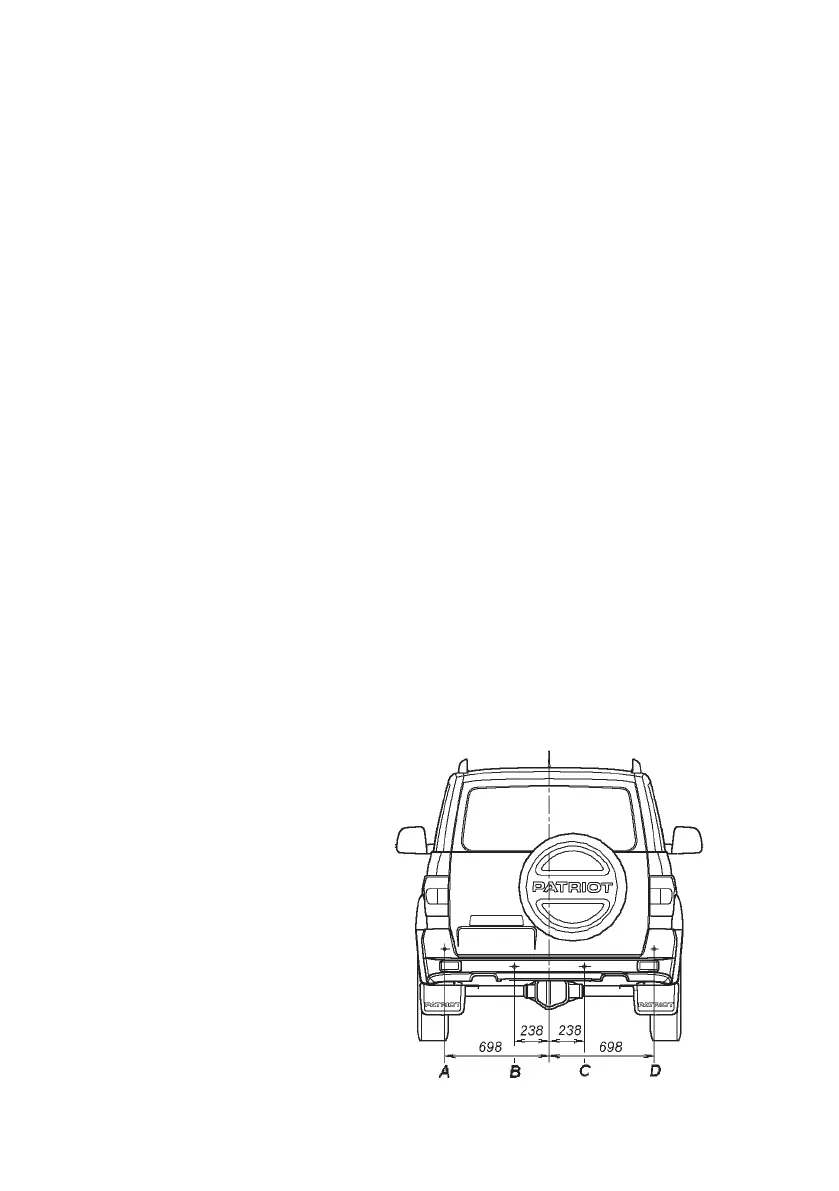
– if sensor A (left, as viewed in the direction of motor vehicle
motion Fig. 3.11) or its circuit is faulty, the system indicates the
faulty sensor with one low-tone horn with a duration of 0.5 s;
– if sensor B or its circuit are faulty the system the system
indicates the faulty sensor with two short low-tone horn with a
duration of 0.3 s;
– if sensor C or its circuit is faulty, the system indicates a faulty
sensor with three short low-tone horns with a duration of 0.5 s and
interval of 0.3 s;
Fig. 3.16. DPS sensor layout:
A, B, C, D — sensors.



 To Next Page