Chapter 6. Solid-State NMR Experiments
107
VNMR 6.1C User Guide: Solid-State NMR 01-999162-00 C0402
Macro
The macro r2selpuls1 converts a parameter set, obtained with XPOLAR or
XPOLAR1, for rotational resonance with selective inversion, R2SELPULS1. Power levels
and the proton 90
° pulse width are retained. The length of the inversion pulse is estimated
to be 50*pwx and the power is set accordingly. Fine calibration of the inversion pulse is
required.
Parameters
r2selpuls1 uses
UNITY
INOVA and UNITYplus parameters tpwr, tpwrm, dpwr,
cppwr, dipolr, crossp, dblvl2, pw, and cntct. See page 85 for a description of
these parameters. The selective inversion pulse must be calibrated.
pwx is the observe 90
° pulse, in microseconds.
p1 is the observe selective-inversion pulse, in microseconds. The default is 50*pwx. For
closely spaced resonances, p1 may need to be longer to achieve greater selectivity. It
should be noted that for strong coupling, significant mixing occurs during the inversion
pulse and so a shorter (less selective) inversion pulse may be preferred.
tpwrms is the observe linear modulator setting for the selective pulse. The default is
tpwrm/50. To obtain tpwrms for a given inversion pulse length p1, set tof2 (see tof2
below), set mix to 0.0, and array the value of tpwrm about the default value. Choose the
value corresponding to the maximum negative signal for the resonance of interest.
tof2 is the transmitter offset of the resonance to be selectively inverted. To obtain tof2,
use xpolar1 to acquire a spectrum in a second experiment, place the cursor on the
resonance of interest, and enter movetof. Set tof2 in r2selpuls1 equal to the this
tof.
mix is the mixing period in milliseconds. Use caution, because setting dm='y' during
the mix period may lead to an unacceptable duty cycle.
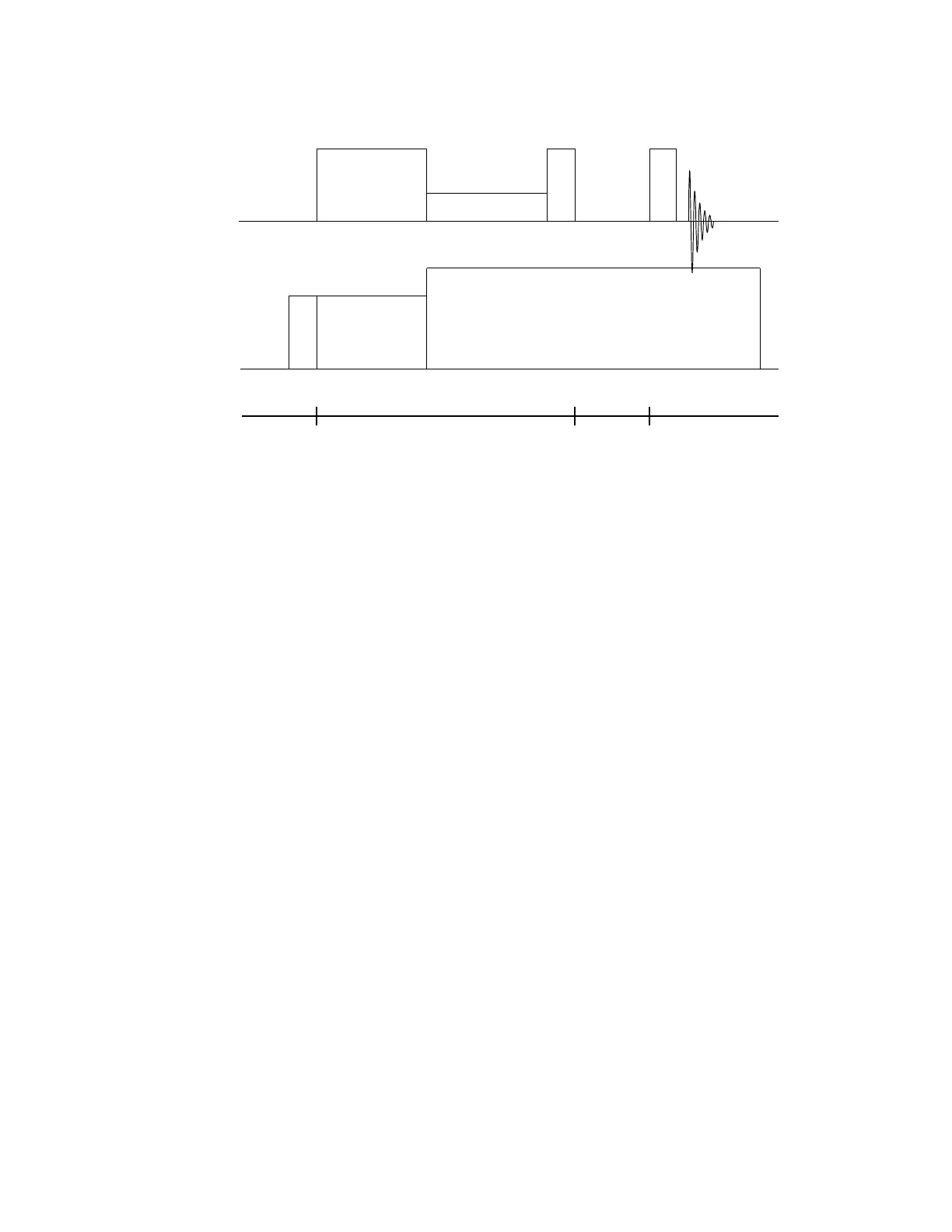
Figure 46. R2SELPULS1 Pulse Sequence
pw
cntct
cntct
(tpwrm)
(crossp)
(dipolr)
Tx
Dec
at
d1
AC
(tpwrm2)
pwx pwx
mix
BC
p1



 To Next Page